1–2% Unit Bankroll Rules for Sports Bettors: Backtest Before Scaling

Set aside a dedicated bankroll you can afford to lose, then risk 1% to 2% of it per bet using a fixed unit size. Track every wager, set a stop-loss and stop-win for each session, and never reload once you hit either limit. That’s the baseline. Everything else, including when to scale up, is built on top of it, and a tool like Backstedge can help you verify a strategy actually holds up before you increase your unit size.
TL;DR:
- Bettors should start with a bankroll they can afford to lose completely, typically allocating 1% to 2% per bet to minimize risk of ruin.
- Using percentage-based units ensures risk remains consistent regardless of bankroll fluctuations, with 1% to 2% being recommended for most levels of experience.
- Setting session limits with clear stop-loss and stop-win rules helps prevent emotional betting and protects gains or minimizes losses in volatile markets.
- Avoid chasing losses by increasing stakes and instead follow disciplined strategies, including pre-set rules and regular bankroll reassessment.
- Testing strategies through backtesting and small-scale live trials, especially using platforms like Backstedge, improves confidence and reduces overconfidence-driven bankroll risks.
Table of Contents
- What Counts as a Bankroll (and How Much to Set Aside)
- How Much Should You Bet Per Unit?
- How Do You Set Session Budgets and Stop Rules?
- How Do You Handle Variance and Risk of Ruin?
- What Mistakes Wreck Most Bettors’ Bankrolls?
- How Can You Test Bankroll Rules Before You Bet Real Money?
- Does Bankroll Strategy Change by Sport or Bet Type?
- Why Does Discipline Matter More Than Any Formula?
- A Simple Ritual Worth Repeating Every Session
- Turning These Rules Into a Repeatable Process
- Sources
What Counts as a Bankroll (and How Much to Set Aside)
A bankroll is money set aside strictly for betting, separate from rent, groceries, or savings. It isn’t “whatever’s left in checking after payday.” The moment you start pulling from grocery money to chase a Sunday parlay, you’ve stopped managing a bankroll and started gambling with your life.
The right starting number depends on your finances and goals, not on what a betting forum says is standard. A student testing strategies might start with $100. Someone treating this as a serious hobby might commit $500. A bettor with real disposable income and multi-year ambitions might set aside $5,000. The amount matters less than the rule behind it: it has to be money you could lose completely without changing how you live.

Separating the bankroll does two things. It removes the emotional weight from each bet, since you’re not risking rent money on a backdoor cover. It also forces discipline, because a fixed pool with fixed rules is far easier to protect than a floating number that blends into your regular spending.
Before you set that number, a few ground rules help:
- Never fund your bankroll with money earmarked for bills, debt payments, or savings goals.
- Pick an amount you’d be comfortable losing entirely over a bad month.
- Reassess the bankroll size only at planned intervals, not after a single big win or loss.
- If betting starts affecting your mood, sleep, or finances outside the bankroll, that’s a signal to pause and check resources like the National Council on Problem Gambling’s help-by-state directory.
How Much Should You Bet Per Unit?
A “unit” is your standard bet size, expressed as a percentage of your bankroll rather than a flat dollar figure. That distinction matters because a $50 bet means something completely different to a $500 bankroll than it does to a $5,000 one. Thinking in percentages keeps your risk consistent as your bankroll grows or shrinks.
Most bankroll management strategies converge on a similar range. Sporting News and other established guides recommend 1% to 2% of your bankroll per bet for most bettors, with anything above roughly 5% considered aggressive and a real accelerant toward ruin.
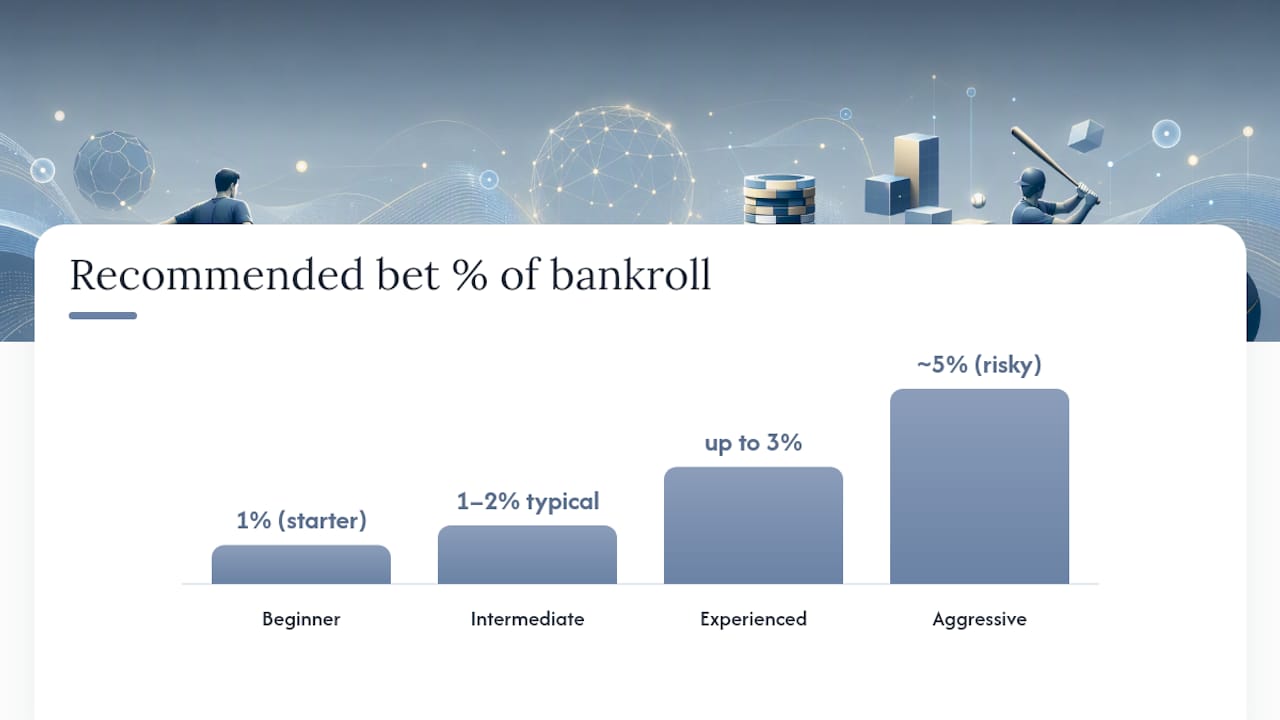
Beginner: about 1% per unit. Intermediate: roughly 1% to 2% per unit. Experienced, with a verified edge: up to around 3% per unit.
Three staking systems put that percentage into practice:
- Flat staking. Bet the same unit size on every play regardless of confidence level. It’s the simplest system and the easiest to track over a large sample.
- Percentage staking. Recalculate your unit as a percentage of your current bankroll after each settled bet, so a losing stretch automatically shrinks your stakes and a winning one grows them.
- Fractional Kelly. Size bets based on your estimated edge and the odds offered, then cut that number to a quarter or half. Full Kelly is mathematically sound but brutally sensitive to bad probability estimates, so most serious bettors use a fraction of it instead, per RationalOdds’ bankroll guide.
Pro Tip: If you’re unsure which system to use, start with flat staking for at least 50 to 100 bets. It’s the easiest to audit, and a clean track record tells you far more than a clever formula applied to guesswork.
How Do You Set Session Budgets and Stop Rules?
Divide your bankroll into a number of sessions you’re comfortable losing across, rather than treating each betting day as unlimited. If your bankroll is $1,000 and you plan to bet weekly across a football season, splitting it into 20 sessions of $50 each keeps any single bad Sunday from wiping out a month of discipline.
Within each session, two limits do the real work:
- Stop-loss: a preset dollar amount or number of units, and once you hit it, you’re done for the day, no exceptions.
- Stop-win: a target where you lock in profit and walk away, since the house edge doesn’t disappear just because you’re up.
- No reloading: if you lose your session budget, adding fresh funds mid session is almost always chasing, not strategy.
- Separate pools by strategy type: keep parlays and live betting in a different mental (or literal) bucket from your core straight-bet strategy, since mixing them hides which approach is actually working.
The stop-win rule gets ignored more than any other, largely because winning feels like it should keep going. It shouldn’t. A session-based staking framework built around preset exits is one of the more reliable ways to keep a good day from turning into a break-even one, and a break-even day from turning into a losing week.
How Do You Handle Variance and Risk of Ruin?
Risk of ruin is the probability that a losing streak wipes out your bankroll before your edge, if you have one, gets a chance to show up in the results. It’s driven far more by your unit size than by how sharp your picks are. A bettor with a real 3% edge betting 10% of bankroll per play can still go broke on a bad run, while a bettor with the same edge betting 1% almost never will.
That’s the core insight bankroll management is built on: the rules don’t create an edge, they protect the runway for an edge to actually pay off. If you don’t have one, tight staking just slows the bleeding.
Two scaling triggers keep the math working in your favor over time:
| Bankroll change | Action |
|---|---|
| Grows about 25%, verified over a real sample | Consider increasing unit size incrementally |
| Drops about 20% from your starting point | Cut unit size and reassess strategy before continuing |
| Betting parlays or props | Hold a larger buffer; these markets carry sharply higher variance |
| On a cold streak within normal variance | Hold size steady rather than doubling down to recover |
Parlays deserve a specific warning. Combining bets multiplies variance rather than adding it, which means a parlay-heavy approach needs a noticeably larger bankroll cushion than straight spread or total bets, according to variance research on bet-type risk. Prop bets carry similar volatility, especially in smaller markets with thinner liquidity.
What Mistakes Wreck Most Bettors’ Bankrolls?
Chasing losses is the single fastest way to accelerate ruin. Betting bigger to “get back to even” after a loss inverts every unit rule you’ve set, because it ties your stake size to your emotional state instead of your bankroll size. If you catch yourself increasing a bet specifically because you’re down, stop and close the app.
A few habits separate bettors who last from bettors who don’t:
- Bet the closing line, or as close to it as possible, and compare your entry price against it regularly, since consistently beating the closing line is one of the better indicators an edge is real.
- Shop for the best number across sportsbooks rather than betting the first line you see; a half point on a spread compounds over hundreds of bets.
- Avoid betting favorites purely because they feel safer. Safety is priced into the odds.
- Record every bet with four fields at minimum: the odds taken, the stake, your estimated win probability, and the result.
Skipping that last habit is more common than it should be. Without honest, dated records, you’re relying on memory to judge your own performance, and memory flatters winners and forgets losers. Line shopping and closing-line value are structural edges that show up clearly in data and disappear almost entirely in vague recollection.
How Can You Test Bankroll Rules Before You Bet Real Money?
Guessing whether a staking rule or a betting strategy will hold up over a full season is a bad habit dressed up as confidence. The more reliable sequence looks like this:
- Write down the exact rule for your strategy, including the sports, bet types, and situations it applies to.
- Run that rule against historical matches to see how it would have performed before you risk a dollar on it.
- Check whether the results are stable across different time periods, not just a lucky stretch.
- Bet a small live sample at your baseline unit size to confirm real-world results match the backtest.
- Scale up gradually, using the drawdown and growth triggers covered earlier.
A no-code platform like Backstedge is built for exactly this workflow: build a rule without spreadsheets, backtest it against historical data, and get a stability read on whether the results are consistent or just a hot streak. Specific capabilities include automated tracking of live bets against your rules and stability analysis that flags whether a strategy’s performance is holding steady or drifting.
That kind of validation matters because overconfidence, not bad math, is what usually breaks bankroll discipline. Seeing a strategy’s real numbers, win rate, average odds, drawdown depth, replaces a gut feeling with something you can actually check.
Does Bankroll Strategy Change by Sport or Bet Type?
Your unit size shouldn’t move just because you switched sports, but your buffer size and bet mix probably should. Baseball’s long season and high volume of games make it easier to build a large, stable sample quickly, which supports tighter, more frequent flat-staked units. The NFL’s short 17-game season means far less data per team, so a single bad beat carries proportionally more weight, and a slightly wider buffer makes sense.
Basketball and soccer sit in between, with enough games to build a real sample within a season but enough scoring variance (basketball) or draw outcomes (soccer) to complicate simple win/loss thinking. Player props across any sport behave more like parlays than straight bets in terms of variance, since they depend on a narrower set of outcomes and often carry thinner liquidity.
The practical adjustment isn’t a different percentage for every sport. It’s building separate tracking for each sport or bet type so you can see whether your edge, if you have one, actually shows up consistently in that specific market. A strategy that wins on NBA spreads has told you nothing about whether it will work on NFL totals. Treat each sport and bet type as its own experiment with its own sample size requirement before you commit serious units to it.
Why Does Discipline Matter More Than Any Formula?
Every staking system on this page assumes you’ll actually follow it when it’s uncomfortable to do so. That’s the hard part. Sticking to it after three straight losses on plays you were sure about is a different skill entirely.
Tilt, the tendency to bet bigger or more frequently after a rough stretch, is the most common way disciplined bettors abandon their own rules mid-season. It rarely feels like a mistake in the moment. It feels like conviction. The fix isn’t willpower; it’s removing the decision entirely by setting stop-loss limits and unit sizes before you start betting, so there’s no judgment call to make while emotions are running the show.
The bettors who last treat their bankroll rules the way a pilot treats a checklist: not as a suggestion to consider, but as a fixed procedure that doesn’t bend just because today feels different. If you notice betting decisions are being driven by frustration, boredom, or the urge to feel action rather than by your written rules, that’s the moment to step back, not press forward.
A Simple Ritual Worth Repeating Every Session
Before you place a single bet, run through four things out loud if you have to: your unit size for tonight, your session budget, your stop-loss and stop-win, and whether you’re actually going to log this bet when it settles. That thirty-second habit catches more bankroll mistakes than any staking formula ever will.
If betting ever stops feeling like a hobby with rules and starts feeling like something you can’t step away from, the National Council on Problem Gambling has state-specific resources worth using. There’s no strategy on this page that outranks that call.
[Author’s professional background and qualifications related to sports betting or data analysis to be added here.]
— Yerowell
Turning These Rules Into a Repeatable Process
Reading a staking rule and actually knowing whether it works are two different things. There are platforms for bettors who want the second part: a way to build a strategy rule without code or spreadsheets, run it against historical matches, and see a stability score before committing real units to it.
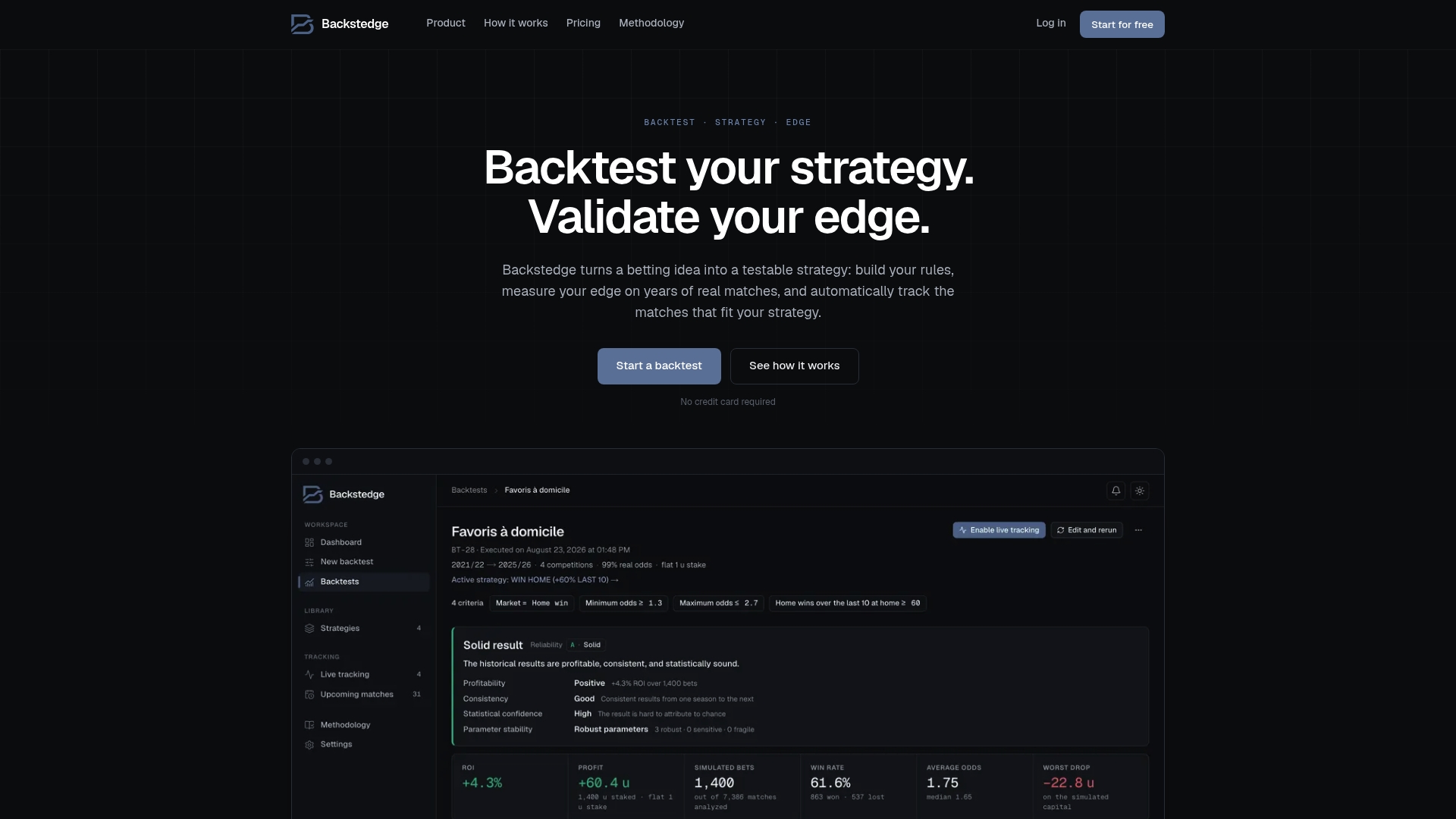
Automated tracking then follows your live results against that same rule, so scaling up stops being a gut call and starts being a decision backed by an actual sample. Start building your first strategy on Backstedge and see what your numbers say before you raise your stake.