Find 2–5% Edges: Expected Value Betting for Sports Bettors, CLV & Kelly

Find 2–5% Edges: Expected Value Betting for Sports Bettors, CLV & Kelly
Expected value tells you whether a bet is mathematically profitable over the long run. The rule is simple: only place bets where your calculated EV is positive, size those bets so a losing streak can’t wipe you out, and track results to confirm the edge is real. A single +EV wager can lose. Calculate EV before every bet, and let the math, not the outcome of any one game, guide your bankroll.
TL;DR:
- Only place bets with an actual positive expected value after accounting for the vig and your true probability estimates, not just potential payout.
- Use sharp closing lines, odds comparison tools, and promo math to find genuine +EV opportunities rather than attempting to out-guess the market.
- Size bets conservatively, typically 1 to 2 percent of bankroll or via fractional Kelly, to manage variance and prevent large drawdowns.
- Verify your edge by tracking closing line value over hundreds of bets and conducting long-term backtests rather than relying on short-term win streaks.
- Avoid emotional reactions during losing streaks by following predefined staking rules and focusing on process discipline instead of outcome.
Table of Contents
- What Is Expected Value Betting and How Do You Calculate It?
- How Do You Read an EV Number Once You Have It?
- Where Do You Actually Find +EV Bets?
- How Should You Size a +EV Bet?
- How Do You Verify Your Edge Is Real?
- Two Quick EV Calculations You Can Copy
- Why Backtesting Confirms an EV Strategy Actually Holds
- How Tilt and Emotion Quietly Wreck a Sound EV Process
- What EV Math Can’t Tell You
- EV Betting vs. Martingale and Flat Betting
- Common Misconceptions About Expected Value Betting
- How EV Looks Different Across Sports and Bet Types
- Build and Backtest Your Own EV Strategy
- Sources
- FAQ
What Is Expected Value Betting and How Do You Calculate It?
Expected value in sports betting is the average profit or loss you’d expect per bet if you placed the same wager thousands of times. The formula is straightforward:
EV = (probability of winning × profit if win) − (probability of losing × stake)
Getting a usable number out of that formula means working through a few conversions first, since sportsbook odds don’t hand you a probability directly.
- Convert odds to implied probability. American odds of −150 imply a significant win probability. Odds of +130 imply a substantial winning chance.
- Remove the vig. Sportsbooks build in a margin, so both sides of a two-way market add up to more than 100%. Divide each side’s implied probability by the total to get the no-vig, or de-vigged, fair probability. This step matters because comparing your estimate to a vig-inflated number will make almost every bet look worse than it is.
- Plug in your true probability estimate. This can come from a sharp market’s de-vigged line or your own model.
- Run the formula. Say a sportsbook offers +130 on a team you (or the sharp market) price at a true 50% to win. Betting $100 to win $130: EV = (0.50 × $130) − (0.50 × $100) = $65 − $50 = $15 in EV per $100 wagered.
That $15 is not a guaranteed profit on this bet. It’s the average outcome if you could rerun this exact scenario many times.
How Do You Read an EV Number Once You Have It?
An EV of $15 per $100 staked equals a 15% EV, which is high compared to typical real-world edges, which tend to be much thinner. Understanding the scale matters as much as the calculation itself.
- Marginal edges (under 1%): Easy to wipe out with a small estimation error or a stale price. Not worth the transaction cost of hunting them down.
- Actionable edges (2% to 5%): The realistic zone for most disciplined bettors, and consistent with the range most EV guides point to as sustainable.
- Strong edges (above 5%): Worth double-checking your probability estimate. Edges this large usually mean either a genuinely stale line or a mistake in your own math.
Statistic to remember: a bettor operating at a steady 3% edge needs a large number of similarly sized bets before variance stops dominating the results. That’s the law of large numbers at work: your win rate on any given week can look nothing like your long-run EV, and a +EV bettor loses constantly along the way. That’s not a flaw in the strategy. It’s the strategy working exactly as the math predicts.
Where Do You Actually Find +EV Bets?
You don’t need to out-guess the market. You need to catch the moments when a retail sportsbook’s line hasn’t caught up to where the sharp market already sits. That price gap, not superior prediction, is where most +EV betting profit actually comes from.
Three practical approaches:
- Benchmark against sharp closing lines. Books known for tight, efficient pricing move fast and correctly. De-vig their numbers and treat that as your best available estimate of true probability.
- Line shop aggressively. A same-game moneyline can vary by 10 to 20 cents across books, which is often the entire difference between a −EV and a +EV bet. Tools built for comparing odds across books, like ParlayGeeks, make this scanning process faster than checking each app manually.
- Evaluate promos on their real math, not the marketing number. An odds boost or bonus-bet credit can be strongly +EV, but only if the boosted payout beats the no-vig fair payout once you account for how the promo actually pays out.
Pro Tip: Boosted odds on parlays often look thrilling but calculate ugly. Convert the boosted payout back to implied probability and compare it to the no-vig parlay price before you touch it, not after.
Operational caveats matter too: books limit or ban accounts that consistently beat closing lines, stake limits on +EV accounts shrink fast, and a “great” price can vanish before you finish clicking. Speed and account longevity are part of the real return, even though they never show up in the formula itself.
How Should You Size a +EV Bet?
Finding an edge is half the job. Sizing it correctly is the other half, and it’s the half most bettors skip.
The Kelly criterion calculates the bankroll fraction that maximizes long-term growth given your edge and the odds offered.
- Estimate your edge and the odds in decimal form.
- Apply Kelly’s formula: stake fraction = edge ÷ (decimal odds − 1).
- On a 5% edge at decimal odds of 2.30, full Kelly suggests staking roughly 3.8% of your bankroll.
Full Kelly is aggressive and punishes a bad probability estimate hard. Most working bettors use fractional Kelly, betting at half or a quarter of the full Kelly stake. Half Kelly captures most of the growth benefit while meaningfully cutting drawdown risk, which is why it’s the more common real-world choice over full Kelly.
If you’d rather skip the Kelly math entirely, a flat 1% to 2% of bankroll per bet is a reasonable default. The one rule that matters more than any formula: never let a single bet’s outcome meaningfully change your ability to place the next hundred bets.
How Do You Verify Your Edge Is Real?
The scariest part of EV betting is that a string of wins can hide a bad process, and a string of losses can hide a good one. Verification separates the two.
- Track Closing Line Value (CLV). Compare the price you bet to the closing price on that same market. Beating the close consistently is a strong leading signal that your probability estimates are ahead of the market, more reliable in the short term than win rate itself.
- Track calibration. When you say something is 60% likely, it should win close to 60% of the time across a large batch of similar bets.
- Give it real sample size. A few dozen bets tell you almost nothing. Meaningful signal typically needs hundreds to low thousands of bets, given how much variance dominates smaller samples.
Two Quick EV Calculations You Can Copy
Example 1: single moneyline bet. A book offers +145 on an underdog. Decimal odds of 2.45 on a $100 stake pay $145 profit if it wins.
- EV = (0.45 × $145) − (0.55 × $100)
- EV = $65.25 − $55 = $10.25, or 10.25% EV.
Example 2: bonus-bet conversion. A $50 bonus bet at +200 odds, if it wins, typically pays profit only (not the stake back).
- EV = (0.35 × $100 profit) − (0.65 × $0, since you risk no cash)
- EV = $35, since a bonus bet’s downside is capped at the lost opportunity, not real money.
Positive EV in either row means bet it. Negative EV means pass, regardless of how good the promo headline sounds.
Why Backtesting Confirms an EV Strategy Actually Holds
A calculated EV on paper is a hypothesis, not proof. The only way to know if a perceived edge survives real market conditions, including how closing lines actually moved across past seasons, is to test it against historical data rather than a handful of recent bets.
This is where backtesting earns its place in the process. Backstedge lets you build a betting strategy’s rules without writing code or maintaining a spreadsheet, then run it against historical matches using real closing odds to see whether the edge held up season over season, or fell apart the moment sample size grew. Its stability analysis flags whether a strategy’s returns come from a consistent edge or a lucky stretch that variance will eventually erase.

A backtest is worth trusting once it covers enough bets and enough seasons that the results stop swinging wildly with each new match added. Only at that point does it make sense to move from paper EV to staking real money.
How Tilt and Emotion Quietly Wreck a Sound EV Process
The math behind expected value doesn’t change when you’re on a five-bet losing streak, but your decision-making usually does. This is the core psychological trap in EV betting: a correctly calculated positive edge will still produce long losing stretches, purely from variance, and most bettors respond to that stretch by abandoning the process instead of trusting it.
Tilt shows up in predictable ways. A bettor chases a loss by doubling a stake outside their sizing plan. Another starts second-guessing a de-vigged probability estimate after two bad beats in a row, tweaking numbers to justify a gut feeling instead of new information. A third stops betting entirely right before a strategy’s edge would have started paying off, because the drawdown felt personal rather than statistical.
The fix isn’t willpower. It’s structure. Decide your stake size and your probability model before you know the outcome of any given bet, then follow that plan regardless of how the last few results felt. Log every bet, including the losses, with the reasoning behind the number you used. Reviewing that log during a rough stretch usually reveals the process was sound and the sample was simply small.
A useful mental shift: stop grading yourself on whether individual bets won. Grade yourself on whether you followed your calculated EV and sizing rules consistently.
What EV Math Can’t Tell You
Expected value is a probability estimate multiplied by a payout. Both halves of that equation depend entirely on how good your inputs are, and that’s the biggest limitation nobody likes discussing: a wrong probability estimate produces a confidently wrong EV number that looks just as clean as a correct one.
Line movement adds another layer of risk. The price you calculated EV against might not be the price you actually get, especially on a popular game where odds shift fast.
EV also says nothing about liquidity or account longevity. The formula assumes you can keep placing similar bets indefinitely. Real sportsbooks actively work against that assumption for bettors who win.
There’s also a subtler risk: overfitting your own probability model to noise. A model tuned heavily on a small sample of past results can look like it finds huge edges everywhere, when it’s actually just memorizing randomness that won’t repeat. That’s precisely why verification through CLV tracking and large-sample backtesting matters more than any single EV calculation.
Finally, EV betting requires patience most casual bettors don’t budget for. Anyone expecting EV math to produce fast, visible results is measuring the wrong strategy against the wrong timeline.
EV Betting vs. Martingale and Flat Betting
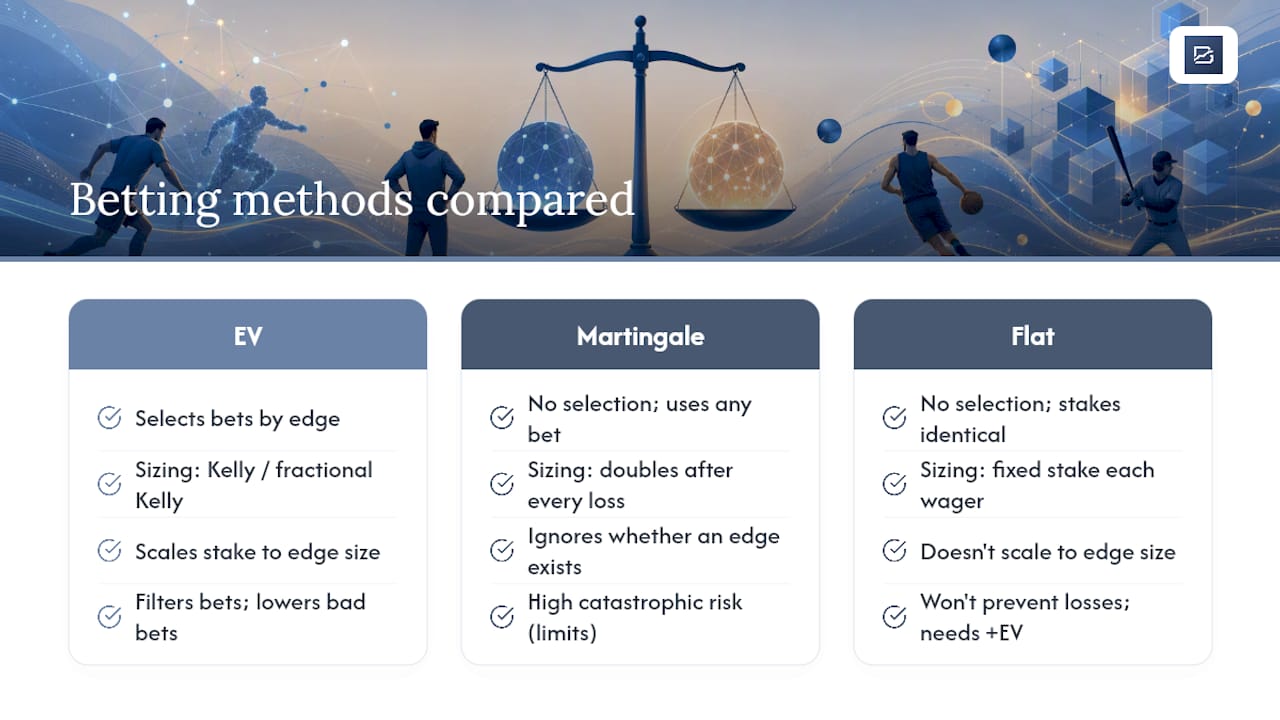
EV betting is fundamentally different from staking systems like Martingale or flat betting, because it’s the only one of the three that actually asks whether a bet is worth making in the first place.
Martingale doubles your stake after every loss, aiming to recover previous losses plus a small profit on the eventual win. It says nothing about whether the underlying bet has any edge at all. Applied to a coin-flip market with no edge, Martingale doesn’t create profit. It just concentrates your losses into one catastrophic bet, since bankrolls and table limits are both finite and losing streaks are more common than gamblers expect.
Flat betting stakes the same amount on every wager, regardless of confidence or edge size. It’s a sizing method, not a selection method. Flat betting can work reasonably well if every bet placed already carries positive EV, but it does nothing to help you find those bets, and it wastes the extra growth available from sizing bigger edges more aggressively.
EV betting does the selection work first: calculate the edge, then decide whether to bet at all. Sizing comes second, often through Kelly or fractional Kelly, which scales the stake to the actual size of the edge rather than applying one flat number to every wager regardless of quality.
The practical takeaway: Martingale and flat betting are staking patterns layered onto whatever bets you happen to place. EV betting is a filter that decides which bets deserve a stake in the first place. A disciplined bettor can combine them, using EV to select bets and fractional Kelly or a flat percentage to size them, but EV has to come first or the sizing method is just organizing bets that never should have been placed.
Common Misconceptions About Expected Value Betting
The biggest misconception is that a positive EV bet is supposed to win. It isn’t. EV describes an average outcome across many repetitions, not a prediction about any single game.
A second misconception treats EV as fixed and objective, when it’s only as good as the probability estimate feeding it. Two bettors can look at the same game, use different probability models, and calculate opposite EV signs on the identical bet. The formula is objective. The input rarely is.
A third misconception assumes any promotion or odds boost is automatically +EV because the payout looks bigger than normal. Boosted odds still need to be compared against the no-vig fair price, and plenty of boosted bets remain −EV once the real math is run, especially on boosted parlays where the vig compounds across legs.
Finally, many bettors confuse a short winning streak with proof of edge, and a losing streak with proof there is none. Neither is reliable evidence on its own. That’s precisely why CLV tracking and sample size matter more than any single week’s results.
How EV Looks Different Across Sports and Bet Types
The math behind EV never changes, but the inputs behave differently depending on the market.
Player-prop and lower-liquidity markets often carry wider, stickier edges because fewer sharp bettors are pricing them and books update them less frequently. That wider edge comes with a real tradeoff: lower liquidity, smaller maximum stakes, and books that limit winning accounts on these markets faster than they do on mainstream moneylines.
What the Data Says: Both Teams to Score Backtested Over 5 Seasons
Football markets built around structural tendencies, rather than one-off mispricing, are exactly the kind of edge that benefits from historical verification. Backstedge’s published backtest of a both-teams-to-score strategy tracks its ROI, profit, worst drawdown, number of bets, win rate, and season-by-season results across five seasons of real closing odds at flat one-unit stakes, giving a concrete look at whether that kind of edge actually held up match after match rather than existing only in theory. You can review the full both-teams-to-score backtest directly.
Totals markets (over/under) behave differently again: EV here often depends more on weather, pace, and lineup news moving the number after open, which rewards bettors who track line movement closely rather than betting the opening price. Futures and outrights carry the widest theoretical edges but also the largest variance and the longest wait to know whether the calculation was right, which makes them the hardest market to verify quickly through CLV alone.
Build and Backtest Your Own EV Strategy
Calculating EV by hand is useful for learning the math. Running that same logic across five seasons of real matches by hand isn’t realistic, and a spreadsheet full of manual odds entries breaks down fast once you’re testing more than a handful of rules.

Backstedge is built for exactly that gap: a no-code way to turn a betting idea into a strategy you can actually backtest against historical football matches, using real closing odds and flat stakes, rather than trusting a gut feeling or a small recent sample. Set your rules, run the backtest, and see the ROI, drawdown, and stability before you ever risk a dollar on it live. If the numbers hold up across seasons, the platform’s automated tracking flags future matches that qualify under your own rules going forward.
Start with the free plan on Backstedge to build your first strategy, or visit Backstedge’s homepage to see how strategy backtesting works before you commit to anything. Build it, backtest it across real seasons, and only then decide whether it deserves your money.
Sources
Check the math with the Smarkets EV explainer, then verify strategies at Backstedge.
- How to calculate expected value in betting
- What is +EV Betting? The Strategy Behind Long-Term Profitability
- Datafield
FAQ
How Do You Calculate the Expected Value of a Bet?
Multiply your estimated win probability by the profit if you win, subtract your loss probability multiplied by the stake, and de-vig the market odds first to get an accurate probability estimate.
Is EV Betting Profitable?
Positive EV betting is profitable over a large enough sample, since the law of large numbers lets the calculated edge show up in your results, but any single bet or even short stretch of bets can still lose regardless of the edge.
How Do I Verify My EV Estimates Are Actually Working?
Track your closing line value over a large sample of bets. Consistent positive CLV, combined with a strategy backtested against historical odds like the ones published on Backstedge, is stronger evidence than any short-term win rate.