Spot 1–2% Edges: Convert Odds to Implied Probability and No Vig %

Spot 1–2% Edges: Convert Odds to Implied Probability and No Vig %
Implied probability converts the sportsbook’s posted odds into a percentage chance of winning. The decision rule that matters follows directly from that number: if your own estimate of the true probability is higher than the implied probability, the bet carries positive expected value. You can pull that percentage out of American, decimal, or fractional odds with a simple formula, or run the numbers through a calculator in seconds, as shown in the cited examples.
TL;DR:
- Implied probability can be quickly calculated from odds formats using simple formulas, with decimal odds offering the clearest conversion method.
- A standard betting market, like -110 / -110, generally sums to over 100% due to the sportsbook’s vigorish, which can be normalized for fair value assessment.
- Removing the vig involves dividing raw implied probabilities by their total sum, enabling comparison between actual fair odds and market prices.
- A positive expected value occurs when your true probability estimate exceeds the market’s implied or fair probability, but it does not guarantee a win on any single bet.
- Backtesting your probability estimates against historical data ensures your model’s accuracy and helps develop strategies resilient to real-world market variations.
Table of Contents
- How to Convert Odds to Implied Probability
- Why Implied Probabilities Add Up to More Than 100%
- Turning Implied Probability Into an Expected Value Calculation
- Worked Examples: From Odds to Fair Probability to EV
- Getting the Most Out of Odds Calculators
- What the Data Says: How Backtesting Builds Defensible True Probabilities
- Backtest Your Strategy Before You Trust the Numbers
- Sources
- FAQ
How to Convert Odds to Implied Probability
Every odds format hides the same number. The formulas just get you there by different roads.
Decimal odds are the simplest. Divide 100 by the decimal price: implied% = 100 / decimal odds. Odds of 1.80 convert to 100 / 1.80 = 55.56% implied probability.
Fractional odds work almost the same way. Take the formula denominator / (numerator + denominator). If you’d rather work from the decimal equivalent, convert the fraction to decimal first, then divide 100 by that number.
American odds split into two rules depending on the sign, and this is where most bettors trip up:
- For positive odds (underdogs), use 100 / (odds + 100) × 100.
- For negative odds (favorites), use |odds| / (|odds| + 100) × 100, using the absolute value so the negative sign doesn’t break the math.
Two examples worth memorizing: -110 converts to 52.38% implied probability, the standard number attached to a point spread.
Round to two decimal places when you’re comparing lines side by side. Anything less precise and small differences between books start to blur together, which is exactly where value hides.
Why Implied Probabilities Add Up to More Than 100%
It never does. That gap is the overround, also called the vig or juice, and it’s how sportsbooks build in a margin regardless of outcome.
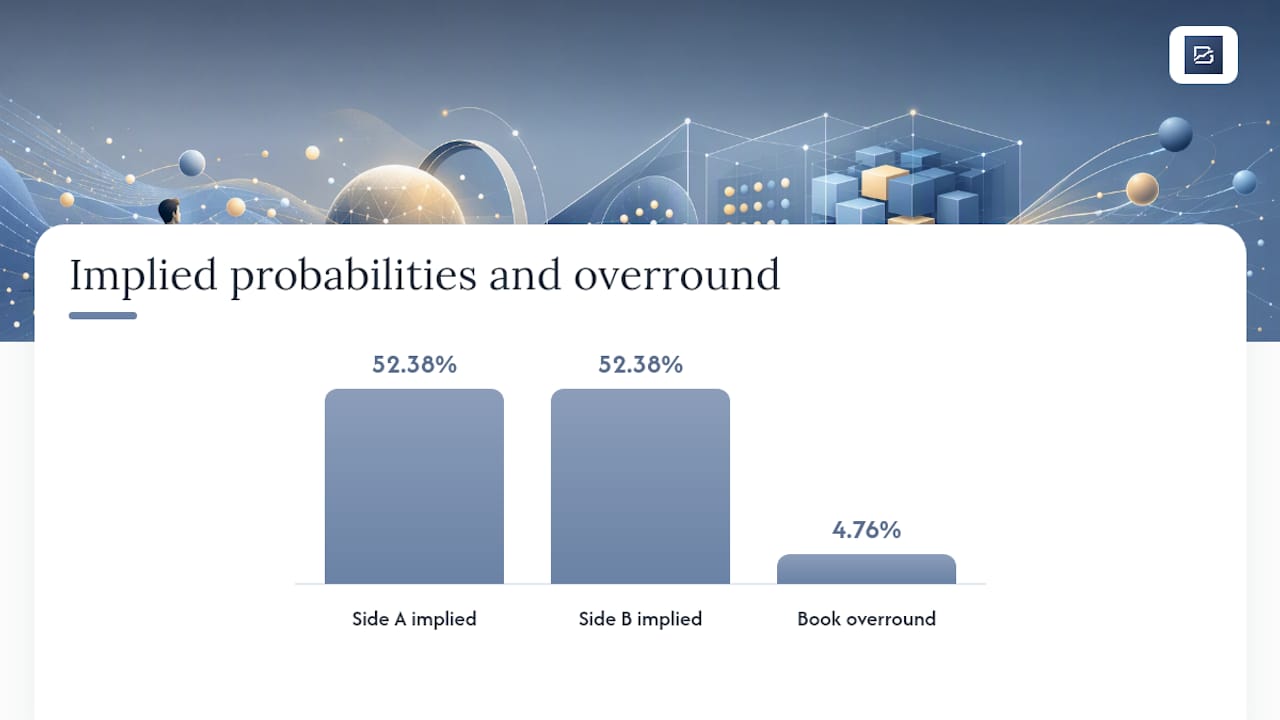
Take a standard -110 / -110 spread. Add them together and you get 104.76%, not 100%. That extra 4.76 percentage points is the book’s cut.
Removing the vig with proportional normalization works in three steps:
- Convert each side’s odds to raw implied probability (52.38% and 52.38% in the example above).
- Sum the raw percentages to find the overround (104.76%).
- Divide each side’s raw implied% by that sum to get the fair, no-vig probability.
You can then convert those fair percentages back into fair decimal or American odds and compare them to what’s actually posted.
Proportional normalization isn’t the only method. Equal-margin devigging spreads the overround evenly across outcomes instead of proportionally, and exponential devigging adjusts for favorite-longshot bias in markets with lopsided prices. Both matter more in multi-outcome markets like soccer’s three-way moneyline, where alternative devigging approaches can shift the fair number by a point or two. As a rule of thumb, a tighter overround signals a more competitive, liquid market; a bloated one often means thin volume or a book protecting itself on a line it’s less sure about.
Turning Implied Probability Into an Expected Value Calculation
The decision rule is simple to state and easy to get wrong in practice: if your true probability estimate (p_true) is higher than the market’s implied or fair probability, the bet has positive expected value.
The formula for expected value as a percentage of your stake is:
EV% = (p_true × decimal odds) − 1
There’s a shortcut version too, useful when you’ve already devigged the market: EV% ≈ (book odds / fair odds) − 1. If the book’s price is generous relative to your fair number, that ratio comes out positive.
Here’s a worked illustration.
- A 1-2% EV edge on a well-modeled line is still worth taking repeatedly; small edges compound.
- A 12%+ edge on a single game is rare enough that it’s worth double-checking your inputs before trusting it.
- Sizing your bet is a separate question from finding the edge. A fractional Kelly approach, betting a conservative fraction of the full Kelly stake, is the common way serious bettors size positions without risking full bankroll swings on one estimate.
Pro Tip: Don’t confuse a positive EV calculation with a guaranteed winner. EV describes what happens on average over many repeated bets with the same edge, not what happens on any single wager.
Worked Examples: From Odds to Fair Probability to EV
Three quick walkthroughs show the full process end to end.
-
Point spread, -110 / -110. Each side converts to 52.38% raw implied probability. Sum: 104.76%. Normalize by dividing each side by 1.0476, and both land at exactly 50% fair probability, which converts back to fair odds of +100 on each side. The book’s -110 price is 10 cents worse than fair on both sides, which is the standard cost of doing business at most sportsbooks.
-
Moneyline, +240 / -300. Raw implied probabilities: 29.41% and 75.00%. Sum: 104.41%. Normalize: 29.41 / 1.0441 = 28.17% fair, and 75.00 / 1.0441 = 71.83% fair. If your model says the +240 side is actually a 33% shot, your EV using the earlier formula comes out around 12%, a real edge against the fair number, not just the raw price.
-
Decimal odds and parlays. A single leg at 2.20 decimal implies 45.45%. Combine that leg with a second at 1.80 (55.56% implied) into a parlay, and the combined implied probability multiplies: 0.4545 × 0.5556 ≈ 25.25%. Overround compounds across legs too, so a parlay’s true house edge grows faster than a casual bettor expects.
Getting the Most Out of Odds Calculators
Most implied probability calculators take the same basic inputs: odds format, the price itself, and sometimes a stake amount to show potential payout alongside the percentage. Entering American odds correctly just means keeping the sign. Type -110 as a negative number and +240 as a positive one; the calculator handles the absolute-value math from there.
Use a devigging calculator automatically when you’re working a multi-outcome market like a soccer three-way line or a golf tournament winner market, where more than two prices need to be normalized together. For a quick two-way spread check, comparing raw implied percentages side by side across books is usually fast enough without a full devig.
A short line-shopping checklist before you place anything:
- Pull the odds from at least two or three books and convert each to implied probability.
- Check the overround on each book’s line. A tighter market usually means sharper pricing.
- Compare the current line to the closing line from previous meetings if you have that history available.
- Confirm the market has enough betting volume that the price reflects real information, not a thin, stale line.
What the Data Says: How Backtesting Builds Defensible True Probabilities
Guessing p_true from gut feel is where most betting models fall apart. A backtest turns that guess into something measurable: run a rule against years of historical matches and you get a real win rate, ROI, number of bets, and worst drawdown instead of a hunch.
- Season-by-season results show whether an edge held up consistently or came from one lucky year.
- Closing-line comparisons across multiple seasons tell you whether your number beat the market’s final, most efficient price.
- A small sample, a handful of bets, is not enough to trust a long-term staking plan even if the early ROI looks strong.
Before committing real money to a probability estimate, building a simple rule and running it against several seasons of real closing odds is the more disciplined next step, and it’s soccer-specific work that platforms like Backstedge are built to handle.
Backtest Your Strategy Before You Trust the Numbers
Converting odds to implied probability tells you what the market thinks. Backstedge tells you whether your own thinking has actually held up over real matches, not just this season’s hot streak. Build a rule with no code, no spreadsheets, and no manual tracking, then run it against historical soccer data to see the win rate, ROI, and worst drawdown it would have produced.

That’s the gap between an implied-probability calculation and an actual strategy. Anyone can spot a price that looks generous on paper. Fewer bettors ever check whether their read on a market, applied consistently across five seasons of real closing odds, would have made money or bled it slowly. The platform described is designed for soccer, with automated tracking that flags qualifying matches going forward to avoid manual re-calculation every week. If you’ve got a rule in your head, from home underdogs to over 2.5 goals to draws between close rivals, build and backtest it on Backstedge before you size a single bet around it.
Sources
The formulas and no-vig methods above draw on FairOdds’ implied probability guide, Omni Calculator’s implied probability tool, and the Wikipedia entry on implied probability. Betting should stay recreational. If it stops feeling that way, the National Council on Problem Gambling offers confidential support and state-level help lines.
- Implied Probability: Formula, Examples & No-Vig Fair Odds · FairOdds
- Implied probability calculator — Omni Calculator
- No-Vig Calculator — Remove Sportsbook Hold | Edge
- Betting Odds Calculator & Converter | Action Network
- Implied probability — Wikipedia
FAQ
What Is Implied Probability in Betting?
Implied probability is a sportsbook’s posted odds expressed as a percentage chance of that outcome happening. Decimal odds convert with implied% = 100 / decimal odds, so a price of 1.80 implies 55.56% implied probability.
How Do You Calculate Implied Probability From American Odds?
For positive American odds, use 100 / (odds + 100). For negative odds, use the absolute value of the odds divided by that absolute value plus 100, which is how -110 becomes 52.38%.
What Does It Mean When Implied Probabilities Add Up to More Than 100%?
That extra percentage is the overround, or vig, the sportsbook’s built-in margin on a market. A standard -110 / -110 spread sums to 104.76% rather than a clean 100%.
How Do You Remove the Vig to Find Fair Odds?
Divide each outcome’s raw implied probability by the sum of all raw implied probabilities in that market. This proportional normalization method turns the vig-inflated numbers into fair, no-vig percentages you can convert back into fair odds.
How Do I Know if a Bet Has Positive Expected Value?
Compare your own probability estimate to the market’s implied or fair probability. If your number is higher, and it holds up when tested against historical results, the bet has positive expected value on paper.
Can I Just Use a Calculator Instead of Doing the Math Myself?
Yes. Most implied probability calculators accept any odds format and return the percentage instantly, though you still need to interpret overround and market liquidity yourself before assuming a number represents real value.