Validate Your ROI Before 500 Bets: Backtest, Log, Track for Bettors

Validate Your ROI Before 500 Bets: Backtest, Log, Track for Bettors
ROI in betting is your net profit divided by total amount wagered, multiplied by 100. The formula is simple: (Net Profit ÷ Total Staked) × 100. A positive number means you’re profitable; a sustained modest positive ROI over hundreds of bets is considered strong for most bettors, while higher ROIs become rare. Small samples, though, can make a bad strategy look brilliant or a good one look broken.
TL;DR:
- Achieving a positive ROI requires consistent, large sample sizes of over 200 bets, with over 500 bets offering more reliable insights into skill.
- Tracking closing line value and managing stake size relative to bankroll are crucial ways to boost long-term profitability.
- Precise logging of each bet detail, including odds and result, helps identify accurate performance and separate skill from variance.
- Improving ROI depends on shopping for better odds, focusing on selectivity over volume, and avoiding distortions caused by poor record-keeping.
Table of Contents
- What Is ROI in Betting and How Do You Calculate It?
- ROI vs Units, Yield, and Win Rate: What’s the Difference?
- What’s a Good ROI in Betting?
- How to Track ROI So the Numbers Actually Mean Something
- How to Actually Improve Your ROI
- Backstedge: Turn ROI From a Lagging Number Into a Testable Hypothesis
- Sources
- FAQ
What Is ROI in Betting and How Do You Calculate It?
ROI measures how efficiently your money works, not just whether you win more than you lose. The formula: ROI = (Net Profit ÷ Total Amount Wagered) × 100.
Here’s the arithmetic in practice:
- You place 100 bets at $50 each, wagering $5,000 total.
- Your total return (winnings plus stakes back) comes to $5,250.
- Net profit = $5,250 − $5,000 = $250.
- ROI = ($250 ÷ $5,000) × 100 = 5%.
This figure matches the kind of result Market Math’s calculator walkthrough uses to illustrate a solid, sustainable outcome.
Now flip it: same 100 bets, same $5,000 staked, but you only get back less than staked, giving you a negative ROI, even if you won 55% of your bets at short odds. Win rate alone tells you nothing about profitability. It’s a classic trap for bettors who track wins and losses but never do the math on stake size and odds.
Pushes and voids shouldn’t count as wagered risk since no money was actually at stake. Free-bet returns typically get counted at their cash value, not their face value, since the site rarely lets you withdraw the stake itself. If you want a broader view of long-term growth rather than per-bet efficiency, calculate bankroll ROI instead: starting bankroll versus ending bankroll over a season.
ROI vs Units, Yield, and Win Rate: What’s the Difference?
These four terms get thrown around interchangeably, and that’s where a lot of bettors lose the thread.
- Win rate measures the percentage of bets you win, with zero regard for odds or stake size.
- Units measure absolute profit in a standardized stake size (useful for comparing bettors with different bankrolls).
- Yield (used more in horse racing and some staking models) is functionally close to ROI but sometimes calculated against a different base, such as total bets placed rather than total staked.
- ROI measures return relative to money risked, which is why it’s the number that actually tells you if you’re profitable.
A bettor hitting 62% win rate on heavy favorites might still post a negative ROI, because the odds barely cover the vig. Meanwhile, a bettor winning just 35% of bets on longshots can run a healthy positive ROI if the payouts are big enough. Track yield when you’re comparing strategies with wildly different staking patterns; track bankroll ROI when your real question is “how much bigger is my bankroll now?” rather than “how efficient was each dollar I risked?”
What’s a Good ROI in Betting?
Benchmarks vary slightly by source, but a common framing (Topend Sports’) places break-even territory at low positive ROI, a positive and sustainable range just above that, higher ROI levels as very good, and very high levels as exceptional and uncommon over large samples.
Maintaining a moderate positive ROI over hundreds of bets typically puts you ahead of the majority of recreational bettors, since most public bettors run negative long-term ROI once the sportsbook margin is factored in, according to mybankroll.io’s benchmark guidance.
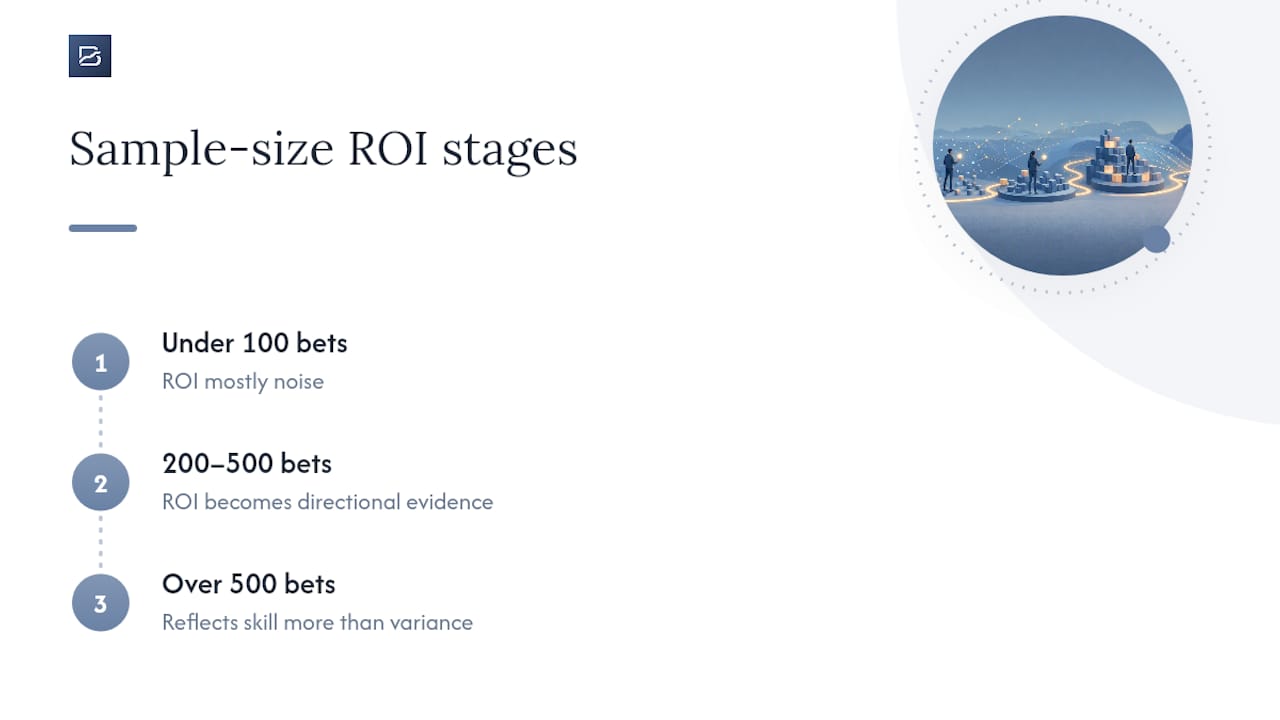
Sample size changes everything about how much you should trust a number. Under 100 bets, ROI is mostly noise; between 200 and 500 bets it becomes more directional; crossing 500 bets usually provides a figure reflecting skill more than variance, per mybankroll.io.
Turnover matters too. A modest positive ROI on a large amount wagered produces proportional profits, so betting more volume at a stable ROI compounds bankroll growth faster than chasing a higher ROI on a small sample. Betting more volume at a stable ROI compounds bankroll growth faster than chasing a higher ROI on a tiny sample.
How to Track ROI So the Numbers Actually Mean Something
Bad logging is the single biggest reason bettors misjudge their own performance. Every bet needs enough detail to reconstruct exactly what happened and why.
Log these fields for every bet, no exceptions:
- Date placed and event date
- Stake and odds at time of bet
- Closing odds (for CLV comparison)
- Market and bet type (moneyline, spread, total, prop)
- Result and payout
- Sportsbook used
Segment your results by sport, bet type, book, and timeframe. Overall ROI can hide the fact that your NFL totals are printing money while your NBA player props are bleeding it dry, a point Market Math’s segmentation guide makes directly. A tool worth using should calculate ROI automatically, track closing line value, break results down sport by sport, and let you export your full log for backup or deeper analysis, similar to what EV Labs’ bet tracker recommends logging.
A spreadsheet works fine for the first few hundred bets. Past that, manually updating rows becomes its own source of error, and a dedicated tracker that pulls closing odds automatically saves hours and catches mistakes you’d never spot by eye.
Pro Tip: Log the closing odds even on bets you’re sure will lose. CLV data on losing bets is just as valuable for spotting whether your timing is actually sharp.

How to Actually Improve Your ROI
Small, consistent edges compound. Here’s where to focus:
- Shop for the best price. Moving from a odds of -110 to -105 on enough bets adds up to real percentage points of ROI over a season, since you’re paying a smaller commission on every winning bet. A resource like ParlayGeeks can help you compare lines across books before you place a bet.
- Choose selectivity over volume. Betting 50 well researched games at 5% ROI beats betting 200 mediocre ones at 1% ROI. Do the math: 50 bets at $100 with 5% ROI nets $250 in profit; 200 bets at $100 with 1% ROI nets $200, for four times the exposure and effort.
- Size stakes to your bankroll, not your confidence. A common approach is capping single bets at 1 to 3% of total bankroll, which keeps a losing streak from wiping out your ability to keep betting. BetMzansi’s bankroll guide covers staking discipline in more detail.
- Track CLV as your leading indicator. VSiN explains that consistently beating the closing line predicts future profitability better than short-term ROI does, since ROI can lag your actual skill level by hundreds of bets.
- Watch for mistakes that distort your numbers. Forgetting to log pushes as risk, excluding losing bets from a spreadsheet, or mixing free-bet returns into cash ROI all inflate the number artificially.
Pro Tip: If your ROI looks too good over your first 50 bets, don’t trust it yet. Wait for a genuine cold streak before you believe the strategy is real.
Backstedge: Turn ROI From a Lagging Number Into a Testable Hypothesis
Most bettors calculate ROI after the fact, once the damage or the profit is already locked in. Backstedge flips that sequence: build a betting strategy with no-code rules, then backtest it against years of historical matches before you risk a dollar on it live.
Instead of guessing whether “home underdogs in derbies” or “away favorites off a midweek Europa League game” actually produce a positive ROI, you define the rule and let Backstedge run it against real historical odds. Stability analysis shows whether that ROI held steady across seasons or got carried by one lucky stretch, which matters given how much sample size affects reliability. Once a strategy clears your bar, automated tracking flags future matches that qualify and monitors real-time ROI as new results come in, so you’re comparing live performance against the backtest instead of relying on memory or a messy spreadsheet.
Start with the free plan at Backstedge and build your first strategy today, or explore published backtest results across ten classic football strategies to see real ROI, drawdown, and win-rate figures before you build your own.
FAQ
What Is a Good ROI for Betting?
A modest positive ROI over a large sample is considered solid and realistic for skilled bettors; substantially higher ROIs over hundreds of bets are exceptional and rare, according to benchmark data from Topend Sports.
Is a 40% ROI Good in Betting?
A very high ROI such as 40% is far outside typical long-term ranges and usually indicates a very small sample size, a lucky streak, or miscalculation; it should be viewed skeptically until confirmed over a large number of bets.
What Does ROI Stand For in Gambling?
ROI stands for Return on Investment, calculated as net profit divided by total amount wagered, multiplied by 100, the same core formula used across general finance and adapted for betting.
How Many Bets Do You Need for a Reliable ROI?
Fewer than 100 bets produces a noisy, unreliable ROI; 200 to 500 bets starts to show directional trends, and more than 500 bets provides more reliable skill indication, per sample-size guidance from mybankroll.io.
If betting stops feeling fun or starts feeling compulsive, resources like GambleAware offer free, confidential support.