Beat the Closing Line: Tennis Betting Strategies With a 15–30 Live Edge
The most reliable approach combines two things: hunting pre-match value with surface-aware models, and picking off one specific live edge, the 15-30 service-game window, instead of betting every point. Do this first: line-shop your next three match-winner bets, filter for hard-court specialists in early-round matchups, and try a paper-traded 15-30 rule before staking real money. Anchor everything to fractional Kelly staking and closing-line value (CLV), and track results the way a platform like Backstedge tracks a backtest, not the way a gut feeling tracks a hunch.
TL;DR:
- Success depends on combining surface-aware value betting with targeting the 15-30 service game window rather than betting every point.
- Prioritize pre-match line comparison, set betting, and surface adjustments, especially for early-round matches and surface transitions.
- The 15-30 micro-bet is most profitable with fast servers on hard or grass courts, but latency and reaction time significantly influence edge exploitation.
- Use fractional Kelly staking or flat units and track closing-line value to avoid variance and validate long-term strategy effectiveness.
- Backtest and verify your rules with historical data to distinguish skill from luck, ensuring your edge is stable before risking real money.
Table of Contents
- Six Tennis Betting Strategies Worth Your Bankroll
- Pre-Match Value: Markets, Set Betting, and Surface Rules
- Live Betting: The 15-30 Edge and the Latency Problem
- Bankroll Rules: Kelly, Flat Staking, and Session Limits
- Closing-Line Value and Where the Market Gets It Wrong
- Testing Your Edge Before You Trust It
- One Week of Testing These Rules
- Turn This Guide Into a Testable Strategy
- Sources
- FAQ
Six Tennis Betting Strategies Worth Your Bankroll
Not every tactic deserves equal attention. Some produce a steady, boring edge. Others only work in narrow situations but pay well when they hit. Here’s the shortlist, ranked by how much return you can realistically expect for the effort involved.
- Surface-aware match-winner value hunting. Compare a bookmaker’s line against a surface-specific rating (not a generic overall ranking) and bet when the gap exceeds a few percentage points. Needs: surface splits, recent form, current odds.
- The +1.5 sets hedge on heavy favorites. Instead of betting a strong favorite to win 2-0, take +1.5 sets, which pays out if they win in either two or three sets. Needs: correct-set odds, historical set-split data for that player.
- The 15-30 live micro-bet. Target dominant servers at 15-30 down in their own service game, where in-play models tend to overreact. Needs: live odds feed, server ace rate, first-serve percentage.
- Early-round underdog spotting on surface transitions. Look for players who historically outperform their ranking right after a surface switch (grass to hard, clay to hard). Needs: tournament calendar, player surface history.
- Correct-set and set-betting mispricing. Books often overstate a favorite’s odds of winning without dropping a set. Needs: conditional set-split probabilities by surface.
- Fatigue and schedule-spot betting. Players who played a marathon three-setter the day before often underperform their listed odds. Needs: previous match duration and date.
Beginners should stick to the first two: match-winner value and the +1.5 sets hedge. Both need only odds and basic stats you can pull from any tennis stats site in a few minutes. The live micro-bet and fatigue-spot strategies reward bettors who already track data consistently and can act fast during a match.
Pre-Match Value: Markets, Set Betting, and Surface Rules
Pre-match betting is where most of your long-term edge lives, because you have time to calculate, compare, and walk away from a bad number. Live betting is reactive by nature. Pre-match is where discipline actually pays.
Start with implied probability. Divide 1 by the decimal odds to get the bookmaker’s implied win chance. Odds of 1.80 imply a win probability just over half. This is the same math behind surface-aware tennis betting models, which recommend building EV calculations around surface-specific data rather than a single blended rating.
Set betting deserves more attention than it gets. A heavy favorite priced to win 2-0 often carries worse value than the same player backed at +1.5 sets, because books tend to overstate how often a dominant player wins without dropping a set. Conditional set-split modeling, tracking “win without dropping a set” versus “win after dropping one” separately by surface, shows many books lean too heavily toward the clean 2-0 outcome for favorites. A favorite who wins 2-1 more often than the market assumes turns +1.5 sets into a quietly profitable habit, especially against a scrappy retriever type who wins games even in a losing set.
Surface matters more in tennis than in almost any other sport. A player’s hard-court Elo rating tells you very little about how they’ll perform on clay three weeks later. Bookmaker models are frequently trained primarily on hard-court data, which means clay and grass windows, especially the first week or two after a surface change on the calendar, are where mispricing shows up most often. Watch for players whose clay-specific hold and break rates diverge sharply from their hard-court numbers; the market often lags behind that adjustment for a tournament or two.
Pro Tip: Build a simple spreadsheet with three columns: implied probability, your surface-adjusted estimate, and the gap between them. If the gap is under 3 percentage points, skip the bet. Below that threshold, the vig usually eats your edge before it eats theirs.
Here’s a ten-item checklist to run through before any pre-match bet:
- Convert the odds to implied probability.
- Pull surface-specific hold and break percentages for both players.
- Check head-to-head results, weighted toward matches on the same surface.
- Confirm neither player has a recent injury flag or retirement.
- Check the tournament round and stakes (early rounds behave differently than finals).
- Compare set-split history if considering a set-betting market.
- Note travel and rest gaps between this match and the previous one.
- Cross-check odds across at least two sportsbooks.
- Decide your stake size before you place the bet, not after.
- Log the closing line for CLV tracking, even if you don’t bet the closing number.
Live Betting: The 15-30 Edge and the Latency Problem
The 15-30 edge is a specific, repeatable live-betting window. When a strong server falls behind 15-30 in their own service game, in-play betting algorithms often overreact to the deficit, pushing the server’s live odds higher than their actual chances of holding warrant. That gap is where the value sits.
The ideal target isn’t just any server. You want a player with a high first-serve percentage and a strong ace rate, playing on a fast surface where holding serve is the default outcome rather than the exception. The edge shows up most reliably against dominant servers on fast courts, where a single lost point doesn’t meaningfully change the underlying probability of a hold.
Filter hard before you bet:
- Avoid matches where either player has already double-faulted repeatedly, since that signals a shakier service game than the pre-match numbers suggest.
- Skip matches with visible injury flags, grimacing, medical timeouts, or a sudden drop in movement.
- Stick to hard and grass courts where hold rates run high; clay softens this edge because breaks happen more often regardless of the score.
- Confirm the server’s opponent isn’t a noted returner who thrives on exactly this kind of pressure point.
Execution matters as much as selection. Treat each 15-30 bet as a micro-bet, not a session-defining wager. A common approach is capping each live bet at a fraction of your normal unit size, since you’re taking more bets with a thinner statistical margin per bet. Some bettors hedge by cashing out once the server reaches 30-30 or wins the point, locking a smaller guaranteed gain instead of riding the full game to its conclusion.
Latency is the part casual bettors underestimate. Standard broadcast streams typically run five to ten seconds behind real court time, and that delay is exactly why professional traders and courtsiders can exploit micro-bets more consistently than someone watching a delayed stream and betting off what they see. By the time you react to a point you watched, the market has often already moved.
Statistic Callout: Broadcast latency commonly runs 5 to 10 seconds behind live play, a gap the betting industry is actively working to shrink below two seconds. Until that gap closes, stream-based bettors are structurally behind sharper, lower-latency operators on fast in-play windows.
Pro Tip: If you’re betting live off a delayed stream, build in a rule that compensates for the lag, like only betting the 15-30 edge in the game immediately after you’ve confirmed the score through a low-latency data feed, not the moment you personally see it happen on screen.
Bankroll Rules: Kelly, Flat Staking, and Session Limits
Your staking method decides whether a real edge survives long enough to pay off, or gets wiped out by a bad week before it has a chance to prove itself. The Kelly Criterion calculates an ideal bet size based on your estimated edge and the odds offered, but full Kelly stakes are aggressive enough to produce brutal swings even when your model is correct. Most retail bettors do better with a quarter of that number, often called 0.25× Kelly, which smooths out variance while still scaling stakes to your actual edge rather than betting the same amount on every pick regardless of confidence.
If Kelly math feels like overkill, flat staking works fine as a starting point:
- Set a unit size at 1% to 2% of your total bankroll, and never change it mid session based on how you’re feeling.
- Cap live-betting sessions at a fixed number of units, say five to eight, so a bad run of 15-30 bets can’t spiral into a bankroll-threatening night.
- Treat any single bet loss as informationless. One result tells you almost nothing about whether your model is right.
- Reassess your unit size only after your bankroll changes meaningfully, not after every win or loss.
Record-keeping separates a real edge from a lucky month. Log the odds you took, the closing odds, your stake, and the result for every single bet. Over a large enough sample, the gap between your average odds and the closing line (your CLV) tells you more about whether your strategy actually works than your win rate does. For a practical primer on unit sizing and setting hard limits before variance takes over, bankroll management guidance built for bettors covers the basics well. If betting ever stops feeling like a calculated hobby and starts feeling compulsive, BeGambleAware’s resources are worth using before it becomes a bigger problem.
Closing-Line Value and Where the Market Gets It Wrong
Closing-line value is the single best signal for whether you actually have an edge, better than your short-term win rate, which can lie to you for months. CLV measures the gap between the odds you took and the odds available right before the match starts.
Tracking CLV rather than just outcomes is what separates a genuine edge from short-term variance.
Markets misprice in predictable spots:
- Early-round matches at majors, where public money piles onto recognizable names regardless of surface fit.
- The first week or two of a new surface swing on the calendar, before models catch up to how players are actually performing.
- Matches involving a player who just played a long three-setter, where fatigue isn’t fully priced in.
- Late withdrawal announcements, where lines move slowly enough to create a brief window.
Analysts covering major tournaments regularly flag these exact patterns, noting how crowd favorites get overbet relative to their surface-adjusted chances, particularly in marquee matchups where public sentiment outweighs the numbers. Shopping lines across multiple books before you bet, and comparing correlated markets like match winner against total games, helps you spot which book has the softest number and reduces how much vig eats into your edge. Tools built for comparing odds and building shareable bet slips can speed up that comparison instead of checking five apps manually.
Testing Your Edge Before You Trust It
A strategy that wins ten bets in a row could be skill or could be noise, and you cannot tell the difference from ten bets alone. Backtesting guidance generally recommends gathering at least a couple hundred qualifying samples before treating a rule as a real edge rather than a lucky streak.
A proper backtest needs a few specific inputs: the filters that define your strategy (surface, round, odds range, player ranking gap), a consistent odds source so you’re not comparing apples to oranges, and enough historical matches to hit that sample threshold. Stability analysis, checking whether your edge holds up across different time periods and sub-samples rather than clustering around one lucky stretch, matters just as much as the headline ROI number.
This is exactly the kind of work Backstedge is built for. Instead of manually tracking bets in a spreadsheet, you can:
- Build a rule (like “surface-specialist underdog, early round, odds between 2.20 and 3.50”) without writing a line of code.
- Run that rule against historical matches to see how it would have performed.
- Get automated stability analysis showing whether the edge is consistent or concentrated in a few outlier results.
- Let the platform flag upcoming matches that qualify under your rule in real time.
The point isn’t to trust every backtest blindly. It’s to stop betting a “feeling” and start betting something you’ve actually measured.
One Week of Testing These Rules
Last month, an underdog clay specialist ranked outside the top 80 caught my eye in an early-round match against a hard-court favorite three weeks into the clay swing. The surface-adjusted numbers favored him more than the market did. I paper-traded the pick first, logging the odds I would have taken (2.60) against the eventual closing line (2.20), which confirmed real CLV before a dollar was on the line.
The lesson wasn’t that the pick won. It was that paper-trading forced me to write the rule down precisely enough to test it again. A vague hunch about “clay specialists getting overlooked” became a specific, repeatable filter, one I could run against a hundred other matches instead of trusting my memory of a handful of good calls.
— Yerowell
Turn This Guide Into a Testable Strategy
There are platforms available that let you check whether your surface-aware rules and 15-30 filters actually hold up, instead of guessing after a good week or a bad one. You can build a rule like “hard-court favorite, early round, odds between 1.60 and 2.00” without touching a spreadsheet, then run it against historical matches to see the real ROI and whether the edge is stable across different stretches of time.
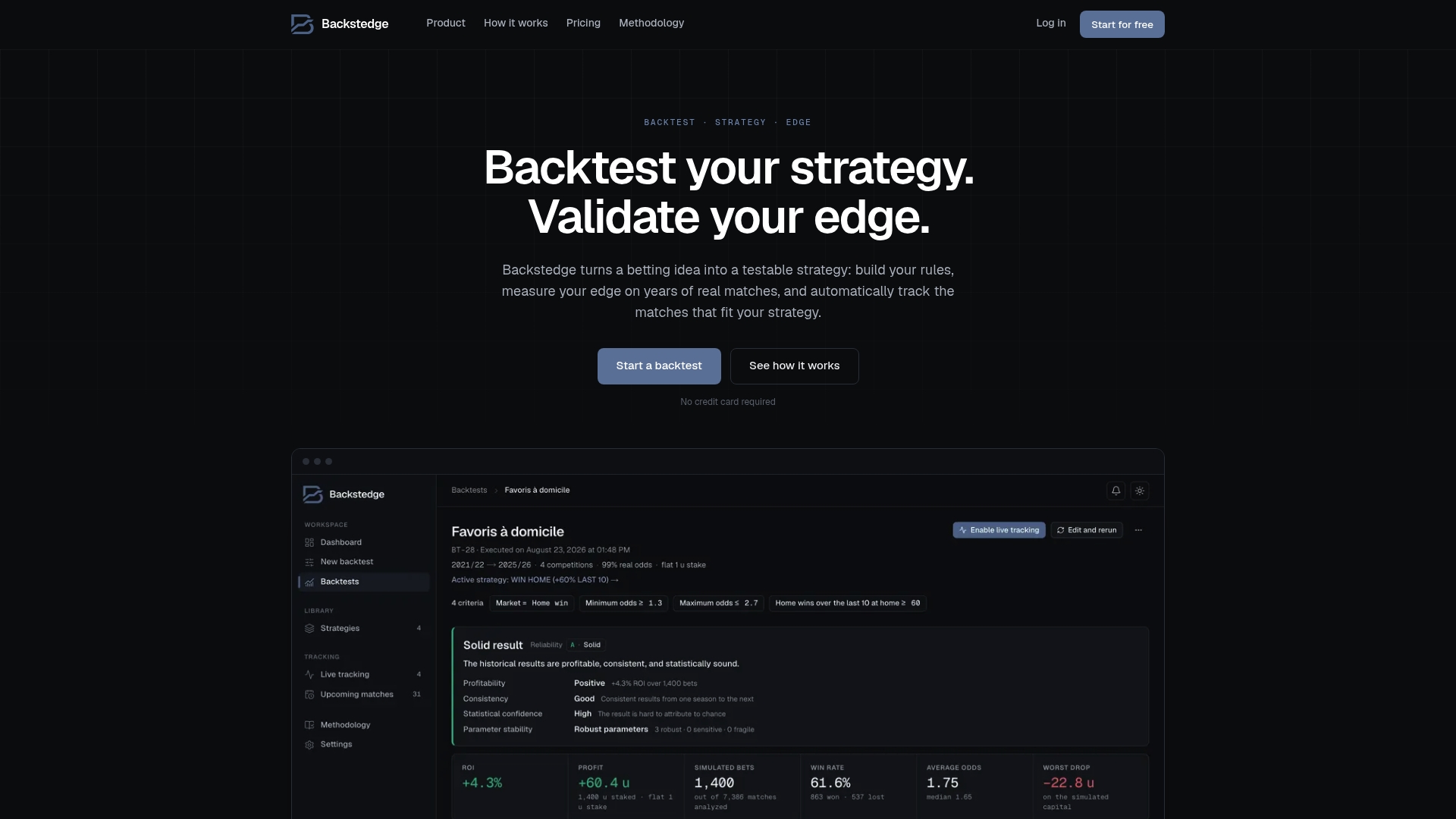
Automated stability analysis flags whether your edge is consistent or just a lucky cluster of results, and real-time tracking shows which upcoming matches already qualify under your rule. If you’ve been betting on instinct, start backtesting your first strategy against real historical data and see what the numbers actually say before you stake another dollar on a hunch.
Sources
- Betting industry aims to cut stream latency below 2 seconds — The Broadcast Bridge
- How to Bet on Tennis Online (2026 Guide) — TIPERO
- The 15-30 Edge: Expert Live Tennis Betting Strategy — The Wager Theorem
- BeGambleAware — Responsible gambling resources
FAQ
What is the most profitable way to bet on tennis?
The most consistently profitable approach pairs surface-aware pre-match value hunting with disciplined fractional-Kelly staking, supplemented by a narrow live tactic like the 15-30 service-game edge rather than betting every point of a match.
What is the most successful betting strategy overall?
There’s no single strategy that wins every time, but the common thread among successful bettors is tracking closing-line value over win rate, since consistently beating the closing number is a stronger signal of a real edge than any short winning streak.
What is the 1-2-3-5 betting strategy?
The 1-2-3-5 system is a progressive staking pattern where you increase your bet size after wins in a set sequence, but it doesn’t change your actual win probability and carries real bankroll risk during a losing run, so most disciplined bettors prefer flat staking or fractional Kelly instead.
What is the best strategy in tennis betting for beginners?
Beginners get the most reliable results from match-winner value hunting using surface-specific stats and the +1.5 sets hedge on heavy favorites, both of which require only odds and basic surface data rather than live in-play reflexes.
How do I know if my tennis betting strategy actually works?
Track closing-line value and log at least a couple hundred qualifying bets before drawing conclusions; a platform like Backstedge can run that same check against historical matches through automated backtesting rather than months of manual spreadsheet tracking.