Underdog Betting Strategy: 5 Season Soccer Backtest and CLV Rules

Underdog Betting Strategy: 5 Season Soccer Backtest and CLV Rules
Selective, data-driven underdog betting can be a profitable long-term approach, but only when you apply strict filters, proper sizing, and closing line value verification. The edge shows up in specific windows, like early-season NFL home dogs and moneyline plays in MLB, not in blindly backing every plus-money team. A five-season backtest of home underdogs in soccer shows how that kind of selective rule performs when measured honestly.
TL;DR:
- The most profitable underdog betting strategies focus on specific windows like early-season NFL home dogs and moneyline plays in MLB, not betting every plus-money team blindly.
- MLB and NHL offer the highest success rates for moneyline underdog plays, while NFL and NBA players should emphasize spread coverage and situational filters rather than outright wins.
- Proper stake sizing, such as fractional Kelly, and tracking closing line value are crucial to preserving long-term profitability of a filtered, data-driven underdog approach.
- Testing and refining filters with historical data before risking real money remain essential to ensure an edge rather than chasing noise or narrative-based bets.
Table of Contents
- What Is an Underdog Betting Strategy, Exactly?
- Why Underdogs Sometimes Have Value
- Which Sports Actually Favor Underdog Betting?
- What Filters Actually Produce an Edge?
- How Should You Size Underdog Bets?
- Moneyline, Spread, or Parlay: Which Market Wins?
- Closing Line Value: The Real Scoreboard
- What the Data Says: Home Underdogs Backtested Over 5 Seasons
- A Step-by-Step Checklist for Placing an Underdog Bet
- Is Underdog Betting Legal, and Are There Ethical Considerations?
- Ready to Test Your Own Underdog Rules?
- Sources
- FAQ
What Is an Underdog Betting Strategy, Exactly?
An underdog betting strategy is a rule-based method for identifying which plus-money teams carry more win probability than the odds imply, then betting only those spots instead of every underdog on the board. That distinction, selective versus blanket, is the entire game.
Most bettors who “like dogs” are really just reacting to a story: a scrappy team, a bad beat last week, a coach with something to prove. That’s narrative betting, not value betting. A real underdog betting strategy runs on numbers: implied probability, historical win rates by situation, and price movement. The rest of this article walks through how to build one, where the actual data supports it, and where it falls apart.
Why Underdogs Sometimes Have Value
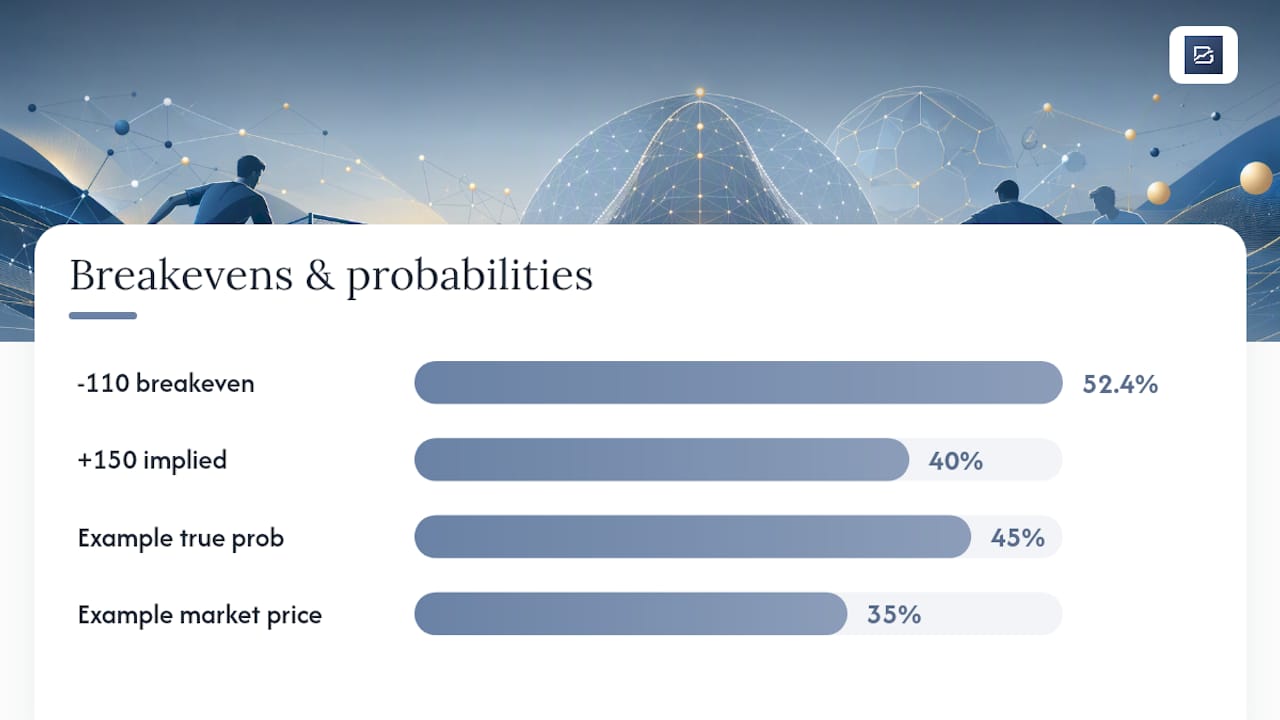
Value in betting means getting better odds than a team’s true win probability deserves. If a team has a genuine 45% chance to win but the sportsbook prices it at 35%, you have value. The math behind expected value (EV) is simple: EV = (probability of winning × amount won per bet) minus (probability of losing × amount staked).
Here’s the number that matters most: at standard -110 odds, you need to win just 52.4% of your bets to break even, because of the vig (the sportsbook’s built-in cut). Underdog bets carry a different breakeven math since the payout is bigger relative to the risk, but the same principle holds: you’re looking for a gap between the market’s implied probability and the real one.
That gap often exists because of the favorite-longshot bias, a well-documented pattern where bettors overpay for favorites and underpay for underdogs. Public money floods in on the popular team, sportsbooks shade the line to balance action rather than to reflect true probability, and the favorite’s price gets inflated. That mispricing on the other side of the ledger is where dog value tends to live.
A quick worked example: a team priced at +150 has an implied win probability of 40% (100 divided by 250).
Sportsbooks don’t always correct these gaps fast. They’re managing liability across thousands of markets, not optimizing every single line for accuracy, and that lag is exactly what selective filters, fractional Kelly staking, and CLV tracking are built to exploit.
Quick math check: A +150 underdog needs to win only 40% of the time to break even.
- Value = a gap between implied probability and true probability
- Favorite bias inflates favorite prices and depresses dog prices
- Sportsbooks tolerate short-term mispricing because they manage total liability, not per-game accuracy
Which Sports Actually Favor Underdog Betting?
Not every sport treats underdogs the same way, and this is where a lot of bettors waste time applying an NFL mindset to a sport where it doesn’t hold up.
MLB is the friendliest environment for moneyline underdog plays among the major American sports. Since 2016, MLB underdogs have won outright at roughly the low 40% range, while NFL and NBA underdogs win outright closer to the low 30% range. Baseball’s single-elimination-style daily matchups, pitcher-driven variance, and long 162-game season all create more outcomes that defy the seeded favorite than a heavily-scripted NFL game does.
- MLB: Highest underdog win rate among major sports; best for moneyline research given daily pitching mismatches and bullpen variance
- NHL: Similar dynamics to MLB, with goaltending variance producing frequent single-game upsets
- College football/basketball: Wide talent gaps mean underdogs cover spreads more than they win outright, favoring ATS research over moneyline
- NFL: Lower underdog win rate, but situational filters (see below) still produce edges in narrow windows
- NBA: The most efficient market of the group; underdog edges are thin and short-lived
The practical takeaway: if you’re building a moneyline-focused underdog betting strategy, put your research hours into MLB and NHL first. If you’re working in NFL or NBA, shift your focus toward spread coverage and situational filters rather than expecting outright upsets. Those two leagues get more national attention and sharper action, which pushes lines closer to efficient almost immediately. A small structural uptick in underdog success has shown up across several sports since 2016, but it’s not large enough to override the league-by-league gap.
What Filters Actually Produce an Edge?
This is the part most “bet the dog” content skips entirely: the filters that separate a repeatable strategy from a coin flip with worse odds.
- Home underdogs, early season. A multi-season study on NFL home dogs found specific windows with real cover rates well above breakeven, including Sunday Night Football home dogs covering at 55.77% and September games covering at 57.69% ATS. No single home-underdog rule was profitable in every season, which is the honest caveat, but specific windows held up across the sample.
- Small-spread home dogs. Teams getting 3 points or fewer at home carry more predictive noise than big road dogs. The closer the number, the more the market is genuinely unsure, and that’s where your own model can add value.
- Moneyline range discipline. Underdogs priced between +100 and +175 are where your win-probability estimate matters most; the math is sensitive but tractable. Once you’re past +300, you’re increasingly betting variance, not edge, and a single miss can wipe out a long streak of correct calls.
- Situational stacking. Injuries to a favorite’s key starters, short rest for the favorite, a long road trip, or a lookahead spot (the favorite playing a bigger game the following week) all nudge true probability toward the dog. Run differential in baseball, DVOA in football, and net rating in basketball are the advanced metrics worth tracking alongside the situational checks.
- Sample-size discipline. A filter that looks great across 40 games can evaporate across 400. Treat anything under roughly 100 qualifying bets as a hypothesis, not a proven system, and rerun it every season before trusting it with real money.
Pro Tip: Write your filter down in one sentence before you ever place a bet on it. “Home underdog, +100 to +175, division game, favorite on a short week” is testable. “I like dogs in big spots” is not.
How Should You Size Underdog Bets?
Stake sizing determines whether a real edge survives contact with variance, or gets erased by one bad month.
Full Kelly Criterion staking, which sizes your bet as a percentage of bankroll proportional to your edge, is mathematically optimal but brutally volatile in practice. Most experienced bettors use fractional Kelly, typically betting a quarter to a half of what full Kelly recommends, to smooth out the swings while still capturing most of the long-run growth.
Here’s a rough framework by price band:
- +100 to +150 underdogs: stake around 1% to 2% of bankroll per bet at quarter Kelly sizing
- +150 to +250 underdogs: stake around 0.5% to 1.5%, since variance rises faster than the payout justifies
- +250 to +400 underdogs: stake around 0.25% to 0.75%, treating these as lower-frequency, higher-variance plays
Cutting that to a quarter or half size keeps the same directional strategy alive through a losing streak instead of forcing you out of it emotionally, or financially, before the sample size is big enough to mean anything.
Scale up slowly. Once a filter shows consistently positive closing line value across 50 to 100 bets, that’s your signal to increase stake size incrementally, not to double it overnight. Log every bet: odds taken, closing odds, result, and stake. Without that log, you’re guessing about your own performance, not measuring it.
Moneyline, Spread, or Parlay: Which Market Wins?
The market you choose changes the math more than most bettors realize.
Moneyline tends to deliver higher EV than spread betting when the spread is small (3 points or fewer) and the sport’s win probability tracks closely with the moneyline price, which is generally true in MLB, NHL, and tight NFL divisional games. When a team is a live moneyline underdog with a real shot to simply win the game outright, that’s usually the cleaner bet.
Spread betting becomes preferable in the NFL and NBA once the underdog is getting a larger number, because the probability of covering the spread is meaningfully higher than the probability of winning outright.
Parlays are where the math turns against you fastest. Vig compounds with every added leg, so a three-team underdog parlay isn’t just riskier, it’s mathematically worse on a per-dollar basis than betting the same three legs separately. Sportsbook promos and parlay boosts can occasionally flip that math in your favor for a specific promotional window, and a tool like ParlayGeeks can help you track odds and shareable bet slips when you’re evaluating whether a boost is actually worth taking. Outside of those promo windows, singles beat parlays for underdog strategies almost every time.
- Moneyline: best for small spreads and sports where win probability tracks the price
- Spread: best for larger underdogs in NFL/NBA where covering is more likely than winning
- Parlays: avoid by default; only reconsider when a specific boost changes the math
- Live betting: widens the gap between posted price and true probability further, but also widens your own error margin, so treat in-play underdog bets as smaller, quicker decisions, not slower research projects
Closing Line Value: The Real Scoreboard
Win rate lies to you in small samples. Closing line value doesn’t.
CLV measures whether the odds moved in your favor between the time you bet and the time the game closes. If you bet a dog at +160 and it closes at +130, you beat the closing line, and that’s a sign you identified value before the market caught up. Positive CLV predicts long-run profitability even in stretches where your actual win rate is running below breakeven, because it’s measuring your read on the market, not just the outcome of one game.
- Record three numbers for every bet: the odds you saw, the odds you took, and the closing odds.
- Calculate CLV as the percentage difference in implied probability between your price and the closing price.
- Track CLV across at least 50 to 100 bets before drawing conclusions; the signal shows up faster than win-rate signal does, often within a few dozen bets.
- Shop lines across multiple books before betting; the difference between the best and worst available price on an underdog is frequently 10 to 20 cents.
Pro Tip: A spreadsheet works, but a platform built for this automates the CLV comparison and shows you whether a filter is drifting positive or negative before your win rate even has enough games to tell you anything reliable.
What the Data Says: Home Underdogs Backtested Over 5 Seasons
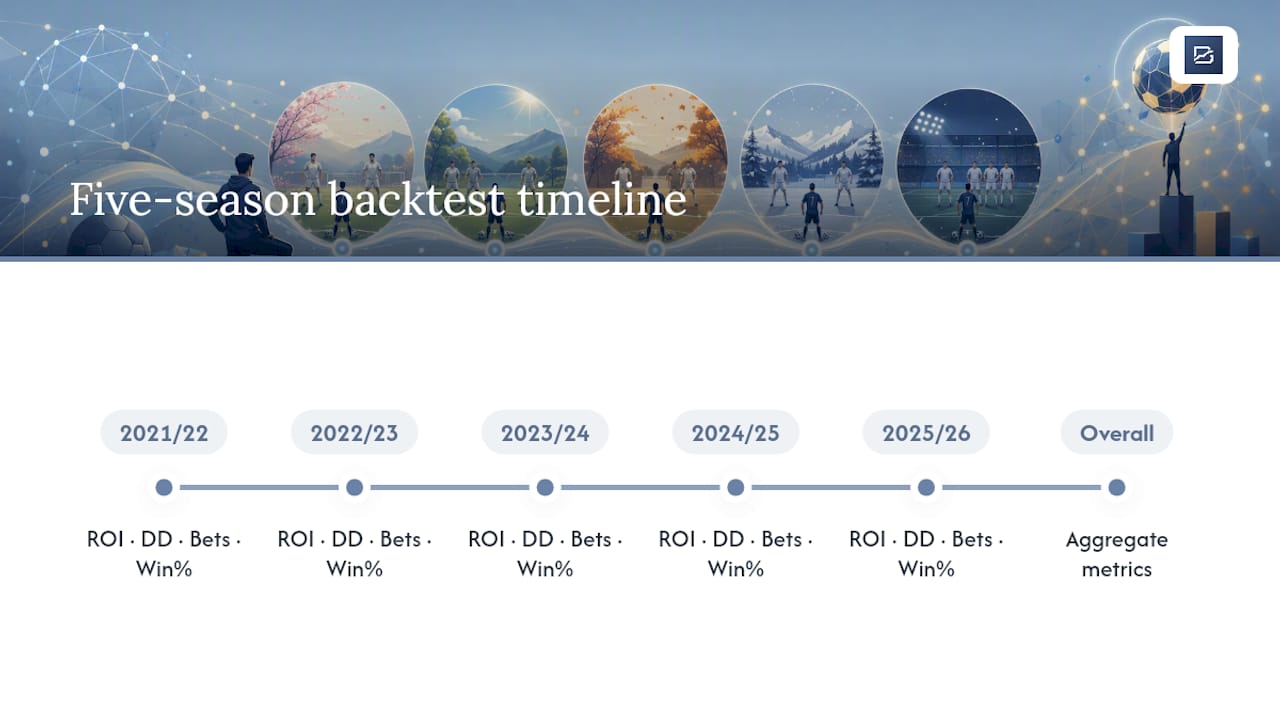
Backstedge ran a five-season backtest on a specific, testable rule: back the home underdog whenever the closing odds are 3.00 or higher, across five major football (soccer) leagues, using flat one-unit stakes and real closing odds from the 2021/22 through 2025/26 seasons. The full breakdown, including season-by-season results, is published on the Backstedge home underdogs backtest page.
The backtest page lists the strategy’s overall ROI, worst drawdown, number of qualifying bets, and win rate over five seasons, along with a year-by-year table showing performance each season rather than just the blended average. That view shows how much results swung yearly, which helps assess the stability of the strategy.
This backtest covers football (soccer) exclusively. The figures do not transfer to NFL, NBA, MLB, or NHL home underdogs, since each sport has its own scoring structure, variance profile, and market efficiency.
A Step-by-Step Checklist for Placing an Underdog Bet
Turn everything above into a repeatable routine, not a one-off decision made an hour before kickoff.
- Compare lines across at least three sportsbooks to find the best available price on your target underdog.
- Run your filter and confirm the game actually qualifies (price band, situational checks, sample-size history) rather than betting on gut feel because the filter “usually” applies.
- Estimate true probability using your model or historical rate for that exact situation.
- Compute EV using the implied probability from the odds versus your estimate.
- Size the stake with fractional Kelly based on the price band and your bankroll.
- Place a single bet, not a parlay, unless a promo genuinely changes the math.
- Log the bet immediately: odds taken, stake, and the closing odds once available.
- Review CLV weekly and win rate monthly, scaling stake size only after a filter shows consistent positive CLV across a real sample.
Pro Tip: Backtest the filter before you ever bet it live. A rule that hasn’t been tested against several seasons of real closing odds is a guess wearing a spreadsheet.
Is Underdog Betting Legal, and Are There Ethical Considerations?
Sports betting legality in the United States is set state by state, and the rules for what you can bet, where, and through which licensed operator vary accordingly. Underdog betting itself isn’t a distinct legal category; it’s simply a betting angle within whatever markets a licensed sportsbook already offers, so if moneyline and spread betting are legal and available in your state through a regulated operator, betting the underdog side of those same markets carries no separate legal question.
The ethical considerations are more about self-management than any external rule. Chasing losses by increasing stakes on underdogs after a bad month is a bankroll-management failure, not a strategy adjustment, and it’s one of the fastest ways to turn a legitimately profitable filter into a ruinous one. Betting more than your bankroll rules allow because “this dog feels right” is the same narrative-driven behavior that value betting is designed to avoid in the first place.
Responsible bankroll limits, honest record-keeping (including your losses, not just your wins), and treating any strategy, including a backtested one, as probabilistic rather than guaranteed are the practical guardrails. No filter, backtest, or CLV history removes variance; it only helps you separate genuine edge from noise over a long enough sample.
Ready to Test Your Own Underdog Rules?
Every filter in this article, home underdogs, small spreads, early-season windows, moneyline price bands, only means something once you’ve tested it against real historical data instead of trusting it on faith. That’s exactly what such platforms are built for: no-code tools where you build custom betting rules, run them against historical matches, and see the ROI, drawdown, and win rate before risking money live.
If home underdogs at 3.00 or higher intrigues you, don’t stop at reading the backtest. Build your own variation, tighten the odds range, add a league filter, test a different season window, and see how the numbers shift inside the platform. Backtest your strategy and validate your edge before you scale real stakes.
Sources
- Using the Home-Underdog Theory to Test the Efficiency of the NFL Sports Gambling Market
- Which sport do betting underdogs win most often? - Covers
- How to Bet Underdogs Profitably: When Long Shots Actually Have Value (2026) - Practical Web Tools
FAQ
Is Underdog Betting a Good Strategy?
Selective underdog betting, built around specific filters like home dogs in narrow spread bands or early-season windows, has shown real edges in studies like the NFL home-underdog research, but blindly betting every underdog produces a roughly breakeven or losing record over time.
How Do You Win Betting as an Underdog?
You win by finding situations where the true win probability exceeds the implied probability in the odds, then sizing the bet with fractional Kelly staking and tracking closing line value to confirm the edge is real rather than luck.
What Is the Most Profitable Betting Strategy?
There’s no single universally profitable strategy; profitability comes from applying selective, tested filters (situational underdog rules, spread thresholds, market timing) and verifying them with positive CLV over a large enough sample, rather than any one bet type being inherently superior.
What Is the 80/20 Rule in Betting?
The rule in betting generally refers to the idea that a small share of your bets, filters, or situational edges drive most of your long-term profit, which is why narrowing down to a few well-tested filters usually beats spreading action across every game on the board.