Bettors, Prove a +1–2% Edge in Hundreds of Bets via Closing Line Value

Closing line value (CLV) measures whether the price you took beat the market’s final number before the game started, and it is the clearest early signal you have of a real, repeatable betting edge. Positive CLV over a large sample tends to predict long-term profit far better than your win rate alone. Start logging your closing lines now, using de-vig prices where possible, and you will know within a few hundred bets whether your process actually works.
TL;DR:
- Consistently logging and analyzing your CLV over hundreds of bets confirms whether your betting process has a true advantage, with +1% to +2% average CLV indicating a reliable edge.
- Using de-vigged odds to compare your bet with the closing line minimizes sportsbook profit margin effects and provides a more accurate measure of your decision’s quality.
- Focusing on early lines and sharp markets, rather than chasing results, helps improve CLV because it captures informed market movements before the market adjusts.
- Automated tools like Backstedge enable error-free, systematic tracking and backtesting of CLV, revealing whether positive results are due to skill or luck.
- Prioritizing CLV and process consistency over win rate prevents misjudging your betting skill, since long-term profit hinges on sustained positive CLV rather than short-term variance.
Table of Contents
- What Is Closing Line Value in Sports Betting?
- Why Does Closing Line Value Matter More Than Win Rate?
- How Do You Calculate Closing Line Value?
- How Should You Track CLV Over Time?
- What Tactics Actually Improve Your Closing Line Value?
- How Backstedge Helps You Validate a CLV Edge
- What Serious Bettors Get Wrong About Closing Line Value
- Backtest Your CLV Strategy Before You Scale It
- Sources
- FAQ
What Is Closing Line Value in Sports Betting?
The closing line is the last price a market shows before the event starts. Most bettors treat it as the market’s most accurate estimate of a game’s true outcome, since it has absorbed every piece of public and sharp money right up to kickoff. Closing line value is the gap between the number you bet and that final price.
CLV shows up in two forms depending on the bet type:
- Point-based CLV: for spreads and totals, it is the raw difference in points. Betting a team at +3 when the line closes at +5.5 gives you 2.5 points of CLV.
- Probability-based CLV: for moneylines, it is the difference in implied probability between your price and the closing price, since odds do not move in even increments the way point spreads do.
Comparing against the raw closing number can mislead you because every price bakes in the sportsbook’s built-in profit margin, known as the vig. Stripping that margin out through a no-vig conversion is what turns a closing price into a fair estimate of true probability. This distinction matters most on moneylines, where vig can shift implied odds by several percentage points depending on the market.
Why Does Closing Line Value Matter More Than Win Rate?
Win rate is loud and immediate, but it is also mostly noise. A single bet can win because of a fluke bounce, a garbage-time score, or a referee’s whistle. CLV strips that variance out and grades the decision itself, not the outcome. You can lose a bet and still have made a sharp call, and you can win a bet on a number the market later proved was terrible.
Industry commentary treats CLV as a decision scoreboard for exactly this reason: a winning ticket can represent a bad decision, and a losing ticket can represent a sharp one, when judged against where the line actually closed.
Statistic: Sharp bettors and industry analysts generally treat an average CLV of roughly +1% to +2% across hundreds of bets as the benchmark that separates a real edge from noise.
The logic behind this holds up because closing markets absorb enormous amounts of information, including sharp money that moves lines toward their true value. Analysts argue this is exactly why the closing line is the most reliable early indicator of long-term profitability, well before win/loss results become statistically meaningful. It also explains why sportsbooks pay close attention to it internally: bettors who consistently beat the close get flagged as sharp, and some books respond by limiting how much action those accounts can place.
How Do You Calculate Closing Line Value?
CLV math is simple once you separate spreads and totals from moneylines. Here is the process, step by step.
- Record your bet’s price and the closing price for the same market, from the same book if you can get it, or from a sharp reference book if not.
- For spreads and totals, subtract your number from the closing number. Betting a total at 47.5 when it closes at 44.5 means you gained 3 points of CLV.
- For moneylines, convert both prices to implied probability, remove the vig from each side, then subtract your implied probability from the closing implied probability.
- De-vig by pairing each side’s odds and scaling both implied probabilities so they sum to 100%, which removes the sportsbook’s built-in margin from the comparison.
Two worked examples make this concrete.
Spread example: You bet a team at -6.5. The line closes at -4. You gained 2.5 points of CLV, a solid result on a market where a single point routinely swings win probability by several percentage points.
Moneyline example: You bet a favorite at -150 (implied probability of 60%). It closes at -180 (implied probability of 64.3%). After de-vigging both prices to remove the bookmaker’s margin, say your fair price was 58% and the fair closing price was 62%. Your CLV is +4 percentage points, a meaningfully positive result.
Pro Tip: Half-point moves near key numbers like 3 and 7 in football carry outsized value because so many games land on those exact margins. A move from +3 to +3.5 is worth far more than a shift from +9 to +9.5, even though both are technically half a point.
How Should You Track CLV Over Time?
CLV only tells you something once you have a real sample to look at. A handful of bets will bounce around too much to draw conclusions, so the goal is a logging habit you can sustain across hundreds of wagers.
At minimum, log these fields for every bet:
- Sportsbook and market (spread, total, or moneyline)
- Your line and odds at the time of the bet
- The closing line and odds for that same market
- Stake and final result
- The de-vig adjustment applied, if any
From that log, compute a few numbers on a weekly or monthly basis: average CLV percentage, median CLV (which resists distortion from one huge outlier bet), sample size, and the variance across your results. Tracking workflows built around these fields let you separate a genuine edge from a lucky stretch.
You do not need to build this from scratch. Dedicated CLV calculators convert point or odds differences into percentage terms automatically, and a platform like Backstedge can pull closing prices automatically instead of asking you to screenshot lines by hand. Automate the data capture; keep your eyes on the weekly and monthly summaries yourself.
What Tactics Actually Improve Your Closing Line Value?
Better CLV is mostly a byproduct of better habits, not a magic system. A few adjustments move the needle consistently:
- Shop your lines across multiple books before betting, since even a half-point difference compounds heavily over a large sample.
- Bet early on soft, slow-moving lines when you have genuine information the market has not priced in yet, and wait on markets that update fast when you do not.
- Stick to liquid, high-limit markets for your CLV benchmark. Thin regional books and promotional lines produce noisy, misleading signals that do not reflect the sharp market’s real number.
- Set a sample-size target before judging results. A few dozen bets tell you almost nothing; a few hundred start to mean something.
Pro Tip: If you are new to line terminology, a glossary of core betting terms helps you avoid misreading implied probability or vig when you are de-vigging your own numbers.
Staking discipline matters here too. Chasing losses or doubling down after a bad stretch has nothing to do with CLV and everything to do with bankroll mismanagement, a risk the National Council on Problem Gambling covers in more depth if betting starts to feel less like a process and more like a compulsion.
How Backstedge Helps You Validate a CLV Edge
Manual CLV logging works, but it is slow and error-prone. Screenshots get lost, closing lines get mistyped, and de-vig math gets skipped when you are busy. Automated tracking removes that friction by capturing closing prices consistently, every time, across every market you follow.
A backtesting engine lets you run a rule set against historical matches to see whether a CLV advantage actually holds up across a real sample, rather than a handful of recent bets that happen to look good. Stability analysis then shows whether that edge stayed consistent across different stretches of the season, or whether it was concentrated in a short lucky run. That distinction is exactly what separates a durable process from noise dressed up as skill.
What Serious Bettors Get Wrong About Closing Line Value
Most bettors treat CLV as a nice-to-have stat instead of the primary thing worth optimizing. That is backwards. Win rate feels satisfying in the moment, but it is a terrible short-term teacher because variance swamps skill over any sample under a few hundred bets. CLV strips that variance out and shows you, bet by bet, whether your process holds up against the sharpest information available.
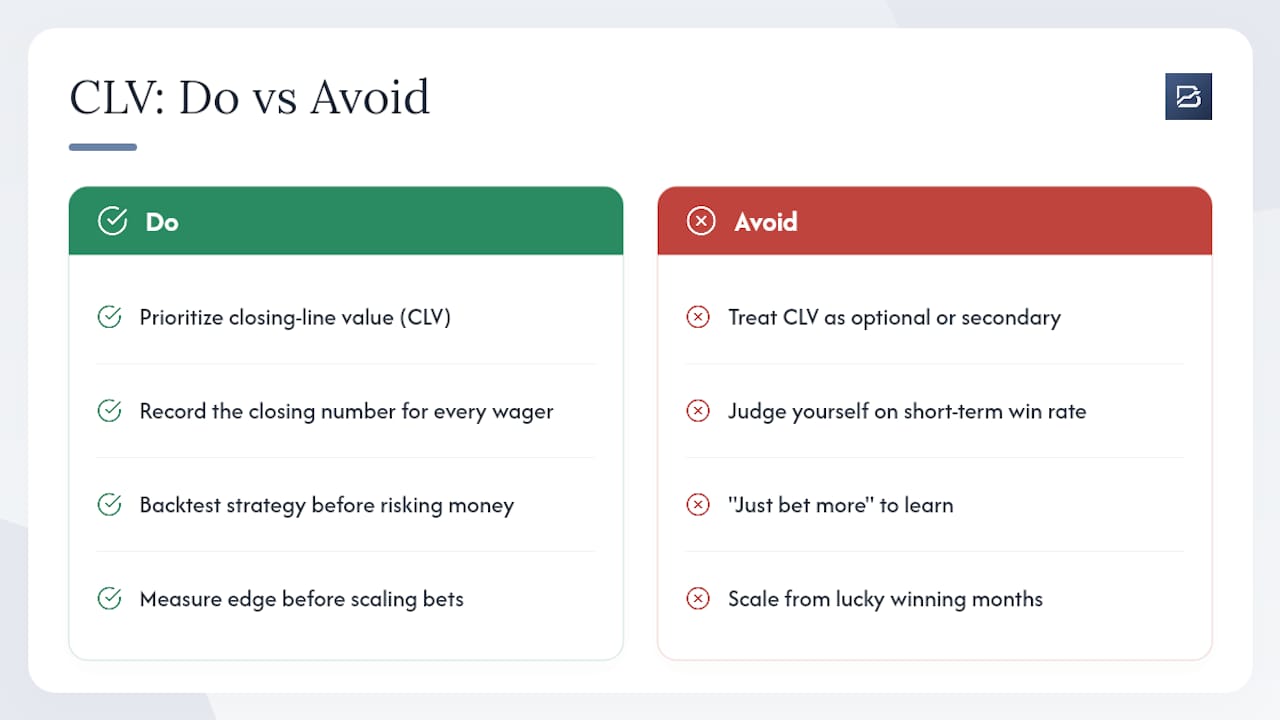
The conventional advice, “just bet more and see how it goes,” ignores that a losing month can still be full of sharp decisions, and a winning month can be full of bad ones that got lucky. Judging yourself on results alone teaches you the wrong lessons for a long time before the truth catches up.
What should come first is not more bets. It is a system for capturing the closing number on every wager you place, without exception, so the sample builds honestly from day one. Backtesting a strategy against historical data before you ever risk money on it is the natural extension of that same instinct: measure the edge before you scale it, not after.
— Yerowell
Backtest Your CLV Strategy Before You Scale It
Backstedge is built for the exact habit this article argues for: measuring your process instead of trusting your gut. Instead of manually logging closing lines in a spreadsheet and hoping you catch every bet, you can build a rule set with no code required, run it against historical matches, and see whether it produces positive CLV across a real sample.
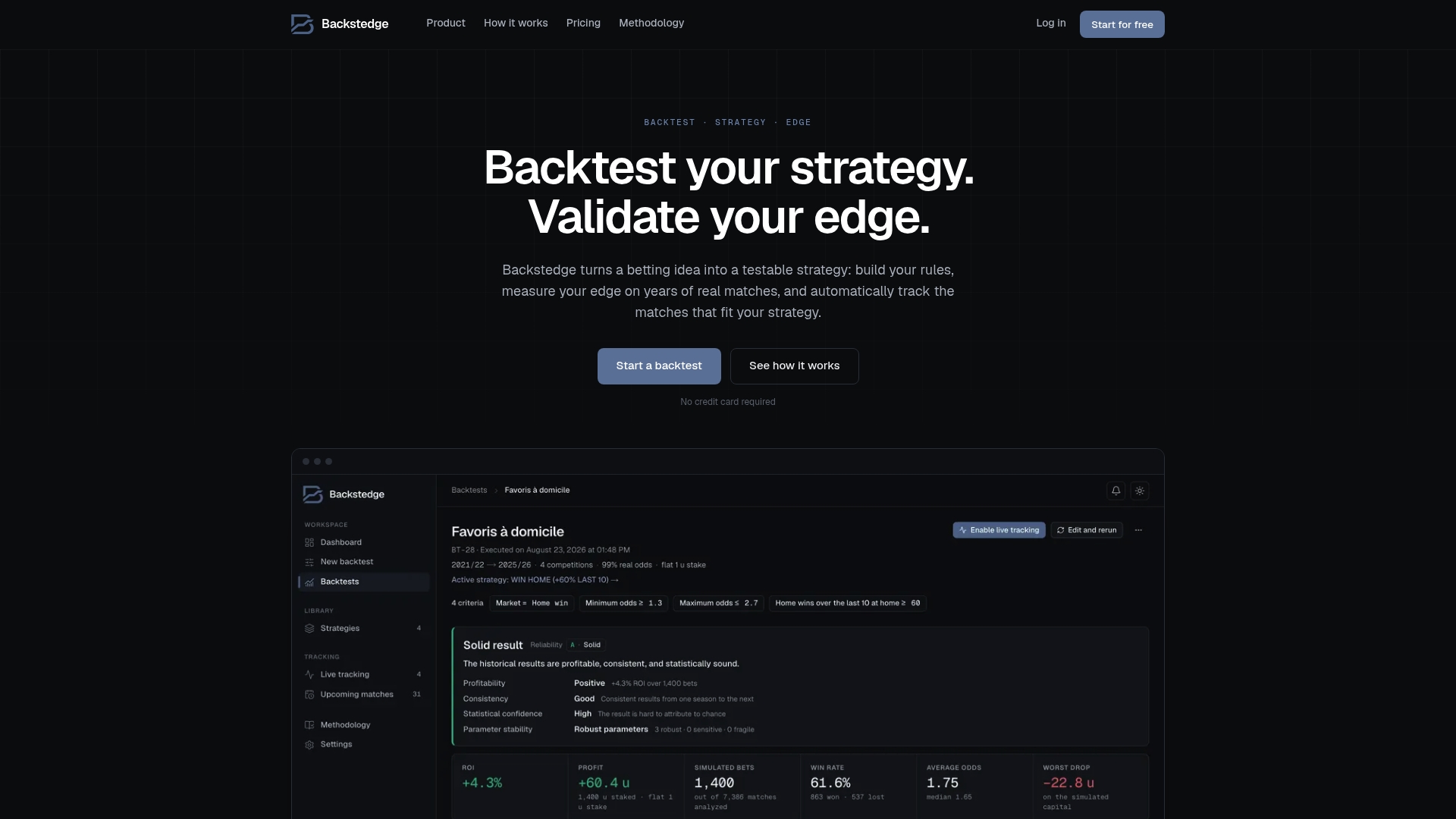
Automated tracking can capture closing prices consistently, and stability analysis can flag whether an apparent edge holds across different stretches of the season or just got lucky in one. If you are ready to stop guessing whether your betting process actually works, start backtesting your strategy with Backstedge and see what the numbers say before you put more money behind it.
Sources
- What’s A CLV in Sports Betting? Closing Line Value Explained
- Why CLV Matters in Sports Betting Explained | Bodog
- Closing-Line Value (CLV) — The Edge Proof | Dynatyze
FAQ
How Is Closing Line Value Calculated?
For spreads and totals, subtract your line from the closing line to get a point difference. For moneylines, convert both prices to de-vigged implied probability and subtract your figure from the closing figure.
Does Closing Line Value Actually Matter?
Yes. It grades the quality of your decision independent of the game’s actual outcome, and sharp bettors treat sustained positive CLV as the earliest reliable sign of a real edge, well before win rate becomes meaningful.
What Is a Good Closing Line Expected Value?
Many sharp bettors target an average CLV around +1% to +2% across hundreds of bets, treating anything consistently above that as a strong signal and anything near zero or negative as a process worth rethinking.
What Does a Closing Line Value Calculator Do?
A CLV calculator takes your bet’s price and the closing price, removes the vig, and outputs the CLV as a percentage or point difference. Tools like Unabated’s calculator automate this, though platforms like Backstedge can also pull closing prices automatically as part of a broader backtesting workflow.