Sports Bettors: Favor Half or Quarter Kelly, Backtest and Track CLV First

Full Kelly is almost never the right answer for sports bettors. The formula, f* = (b·p − q) / b, tells you the exact fraction of your bankroll to stake given your edge and the odds. In practice, most bettors should stake half or a quarter of that number, because full Kelly maximizes growth but produces swings most people can’t stomach. And if the formula spits out zero or a negative number, the answer is simple: don’t bet.
TL;DR:
- Full Kelly maximizes long-term growth but is rarely practical due to high volatility and large drawdowns, making fractional Kelly the preferred choice for most bettors.
- Estimating true win probability accurately is crucial, as overestimating can lead to betting more than your edge justifies, risking bankroll depletion.
- Kelly works best with independently modeled, verifiable edge estimates, and its reliability diminishes significantly if your probability model is unvalidated or biased.
- Regular backtesting and stability analysis of your probability estimates help ensure your Kelly staking plan remains robust against estimation errors.
- Bookmaker limits and line movements can restrict Kelly’s effectiveness, especially when your model suggests larger stakes or when betting into correlated markets.
Table of Contents
- What Is the Kelly Criterion in Sports Betting?
- The Kelly Formula: Variables and Intuition
- Worked Sports-Betting Example: Odds Conversion and Step-by-Step Kelly Calculation
- Fractional Kelly: Why Real Bettors Rarely Use Full Kelly
- Estimating Your Edge: Practical Methods to Get a Defensible P
- Practical Staking Workflow and Tooling for Day-to-Day Application
- Limitations and Risks: Drawdowns, Estimation Error, and Bookmaker Constraints
- Extending Kelly: Portfolios, Correlated Bets, and Multi-Outcome Markets
- How Backtesting and Stability Analysis Reduce Kelly’s Main Weakness
- When I’d Use Kelly Versus Flat Staking
- Backtest Your Kelly Strategy Before You Bet It Live
- Sources
- FAQ
What Is the Kelly Criterion in Sports Betting?
The Kelly criterion is a bet sizing formula, not a betting strategy. It doesn’t tell you which team to bet or where your edge comes from. It tells you, once you already believe you have an edge, exactly how much of your bankroll to risk to grow that bankroll as fast as mathematically possible over the long run.
The formula comes from work John L. Kelly Jr. published in 1956, originally framed around information theory rather than gambling. Kelly showed that if you’re maximizing expected logarithmic growth of wealth across repeated bets, there’s a single optimal fraction to wager on each one. That’s the intuition behind why this formula, decades later, became the backbone of quantitative bankroll management wherever people bet with a real edge, from blackjack card counters to sports bettors running their own probability models.
Here’s where terminology gets muddled online. Some bettors call any percentage-of-bankroll staking plan “Kelly,” even when they’re really just guessing at a flat percentage. True Kelly criterion sports betting requires an actual probability estimate for each bet, not a gut feeling dressed up in math. That distinction matters for everything that follows.
The Kelly Formula: Variables and Intuition
The full formula is f* = (b·p − q) / b. Each variable has a specific, non-negotiable meaning.
- b is your net decimal odds minus 1. If a bookmaker offers you decimal odds of 2.50, b = 1.50, meaning you profit $1.50 for every $1 risked on a win.
- p is your estimated true probability that the bet wins, based on your own model or analysis, not the implied probability baked into the odds.
- q is simply 1 − p, the probability the bet loses.
- f* is the fraction of your total bankroll to stake on this single wager.
Plug in the numbers and the formula does something useful beyond just sizing the bet: it filters out bad bets automatically. If bp − q comes out at zero or below, the correct stake is nothing. No edge, no bet, no exceptions. That single property is arguably more valuable to most bettors than the sizing math itself, because it forces discipline that flat staking never enforces.
The reason this specific fraction is optimal, rather than some other number, comes down to the shape of the log wealth function. Expected log growth is concave, which means there’s exactly one maximum point as you vary the stake fraction. Bet too little and you leave growth on the table. Bet too much, and even with a real edge, the volatility eventually overwhelms the edge and your expected growth rate falls, sometimes catastrophically. Kelly finds that single peak.
Where the formula breaks down is just as important as where it works. It assumes your probability estimate is accurate, that you’re not betting into a book that will limit or ban you before you realize your edge, and that each bet’s outcome is independent of the others. Violate any of those assumptions and the formula’s output becomes unreliable, no matter how clean the arithmetic looks.
Worked Sports-Betting Example: Odds Conversion and Step-by-Step Kelly Calculation
American odds need converting before Kelly means anything, since the formula runs on decimal odds and the b variable derived from them.
- Convert American odds to decimal. For positive odds like +150, decimal odds = (150/100) + 1 = 2.50. For negative odds like −110, decimal odds = (100/110) + 1 = 1.909.
- Calculate b. Subtract 1 from the decimal odds. At +150, b = 1.50. At −110, b = 0.909.
- Estimate p. Say your model puts a team’s true win probability at 45% (p = 0.45) on a bet priced at +150. That makes q = 0.55.
- Plug into the formula. f* = (1.50 × 0.45 − 0.55) / 1.50 = (0.675 − 0.55) / 1.50 = 0.125 / 1.50 ≈ 0.083.
That means full Kelly recommends staking roughly 8.3% of your bankroll on this bet.
On a bankroll example, that translates to a moderate-sized stake proportional to about 8% of total funds. Most bettors will immediately want to cut that number down, and that instinct is correct. This example uses full Kelly purely to show the arithmetic; the next section covers why almost nobody should actually stake the full amount.
Now run the same math on a bet where your edge doesn’t exist. Say the same +150 bet, but your honest estimate of true win probability is only 38%, not 45%. Then bp − q = (1.50 × 0.38) − 0.62 = 0.57 − 0.62 = −0.05. Negative output. The Kelly answer is zero. You pass on the bet, full stop, regardless of how good the game looks on paper.
Fractional Kelly: Why Real Bettors Rarely Use Full Kelly
Full Kelly is mathematically optimal for long-term growth and practically brutal to live with. It produces enormous drawdowns even when your edge is real, because the formula assumes you have infinite time and unshakeable discipline to ride out variance. Most bettors have neither.
Fractional Kelly solves this by multiplying the full Kelly stake by a constant, usually 0.5 (half Kelly) or 0.25 (quarter Kelly), before placing the bet. The tradeoff is remarkably favorable. Half Kelly keeps roughly 75% of full Kelly’s growth rate while cutting volatility by about half. You give up a quarter of your theoretical growth and get back a dramatically smoother equity curve in return.
- Half Kelly (0.5x): the most common default among bettors who track results seriously. Retains most of the growth, meaningfully lower volatility.
- Quarter Kelly (0.25x): favored by bettors with less confidence in their probability estimates or a lower risk tolerance. Growth retained drops further, but drawdowns shrink substantially more.
- Full Kelly (1.0x): reserved for bettors with a long track record, validated probability models, and the temperament to watch a bankroll drop 40% or more without changing the plan.
In practice, applying a half or quarter multiplier to typical sports betting edges tends to produce single-digit percentage stakes on most bets, sometimes well under 5% of bankroll once the fraction is applied. That range feels conservative compared to what bettors chasing action are used to risking, and that’s the point.
Pro Tip: If you can’t say with a straight face what your sample size was for the probability estimate behind a bet, default to quarter Kelly or lower. Confidence in your p should scale directly with how much of your bankroll you’re willing to risk on it.
Estimating Your Edge: Practical Methods to Get a Defensible P
Every Kelly calculation is only as good as the p you feed it. This is where most bettors quietly sabotage themselves, plugging a confident guess into a precise formula and mistaking the resulting number for objectivity.
Three modeling approaches tend to produce more defensible probability estimates than gut instinct:
- Historical-data models that regress outcomes against relevant inputs (team stats, injuries, situational factors) across a large sample of past matches.
- Elo or Poisson-based models, common in soccer and basketball analytics, which convert scoring rates or rating differentials directly into win probabilities.
- Domain-specific models built around a sport’s particular quirks, like pace-adjusted metrics in basketball or expected goals in soccer.
None of these matter if you can’t validate them. The standard way sharp bettors check whether their p is actually accurate, rather than just internally consistent, is tracking closing line value (CLV). If your bets consistently beat the closing line, that’s a much stronger signal of real edge than a short winning streak, because closing lines reflect the sharpest available consensus on true probability.
Sample size matters more than most bettors want to admit. A 20 bet stretch tells you almost nothing about whether your model has a genuine edge. Meaningful validation usually requires hundreds of graded bets, segmented by market type and sport, before you can trust the p your model produces enough to size stakes against it with any real confidence.
Data hygiene rounds out the process. Overfitting a model to a narrow slice of historical data, ignoring selection bias in which bets you chose to track, and blending unrelated markets into one aggregate win rate are the three most common ways bettors convince themselves an edge exists when it doesn’t. Segment your results by league, bet type, and time period before trusting the aggregate number.
Practical Staking Workflow and Tooling for Day-to-Day Application
The math is simple once you have the inputs. The workflow that gets you clean inputs, consistently, is where discipline actually gets tested.
- Estimate p using your model, not your enthusiasm for the game.
- Convert the odds you’re actually offered into decimal form and derive b.
- *Compute full Kelly’s f using the formula.
- Apply your fraction (0.5 or 0.25) and, ideally, a hard cap per bet regardless of what the math suggests.
- Place the stake, log the bet, the odds, your p estimate, and the outcome.
- Update your bankroll before calculating the next stake, since Kelly recalculates against your current bankroll, not your starting one.
Kelly works best on markets where your model produces a stable, independently verifiable probability: single-match moneylines, totals, and spreads where you have a real modeling edge. It works poorly, or not at all, on parlays and same-game combinations, since correlated legs violate the independence assumption baked into the formula and can make your effective risk far higher than the math implies.
Tooling ranges from a basic spreadsheet formula to dedicated calculators to full backtesting platforms. A spreadsheet works fine for occasional bettors placing a handful of wagers a week. Bettors running systematic strategies across dozens of weekly bets tend to outgrow spreadsheets fast, since manually re-tracking CLV, sample sizes, and stake history across multiple concurrent strategies becomes its own part-time job. This is the gap a platform like Backstedge is built to close, letting you build a staking rule once and run it against historical matches automatically rather than rebuilding formulas every week.
Limitations and Risks: Drawdowns, Estimation Error, and Bookmaker Constraints
Kelly’s biggest practical weakness isn’t the math, it’s the p you feed into it. Overestimate your edge and the consequences compound fast: betting at double your true Kelly fraction doesn’t just double your risk, it can drive your expected long-term growth rate to zero even when a real edge exists underneath the error.
- Estimation error is the single biggest failure mode. A probability estimate off by even a few percentage points can turn a theoretically profitable strategy into a bankroll-draining one.
- Drawdowns are mathematically guaranteed, not a sign something’s broken. Even with a legitimate edge, a run of 10 or more consecutive losing bets is well within normal variance at typical sports betting win rates.
- Bookmaker limits cap the whole exercise. A bettor whose model shows a real edge often finds their stake size, or their account itself, capped before Kelly staking ever reaches its full potential.
- Line movement between your bet and game time changes the effective odds you locked in, which is part of why CLV tracking matters as much for risk management as for edge validation.
The behavioral risk is the one bettors underestimate most. Watching a mathematically sound strategy lose money for weeks is genuinely hard to sit through, and the most common failure isn’t a bad formula, it’s a bettor who abandons a validated staking plan mid-drawdown, right before variance turns back in their favor.
Extending Kelly: Portfolios, Correlated Bets, and Multi-Outcome Markets
Real betting activity rarely involves one isolated wager. Once you’re running multiple concurrent bets, the single-bet Kelly formula stops being sufficient, because it assumes each bet is independent of every other one you’re holding.
The full version of this problem, sometimes called the Kelly portfolio problem, requires estimating the covariance between every pair of bets you’re considering simultaneously. Two moneyline bets on the same game, or on divisional rivals whose outcomes tend to move together, aren’t independent risks even if they look unrelated on the surface. Solving this properly means matrix math most recreational bettors, and plenty of professional ones, never bother running by hand.
Practical heuristics fill the gap. Shrinking each standalone Kelly stake when you’re holding several bets at once, capping total exposure to any single game or correlated market group, and leaning on betting-industry analysis from sources like Games Network to spot when markets are moving together are all reasonable substitutes for full optimization.
The safest default: if you can’t confidently estimate the correlation between two bets, don’t size them as if they’re independent. Cap your combined exposure and treat correlated positions as one larger, riskier bet rather than two separate, smaller ones.
How Backtesting and Stability Analysis Reduce Kelly’s Main Weakness
Every limitation covered above traces back to one root problem: an unreliable p. Backtesting a staking rule against historical matches is the most direct way to see whether your probability estimates actually held up before you risk real money finding out live.
Running a strategy through hundreds of past matches reveals things a handful of live bets never will, particularly how sensitive your recommended stake is to small errors in p. A no-code backtesting environment like Backstedge lets you build a rule, apply it retroactively, and see the resulting bankroll curve without writing a spreadsheet formula by hand for every scenario.
Stability analysis takes this further by showing how a strategy’s results shift as you nudge assumptions slightly, which sample sizes actually produced a reliable p and which were too thin to trust. Automated tracking then carries that validation into live betting, logging CLV and outcomes against the same criteria used in the backtest.
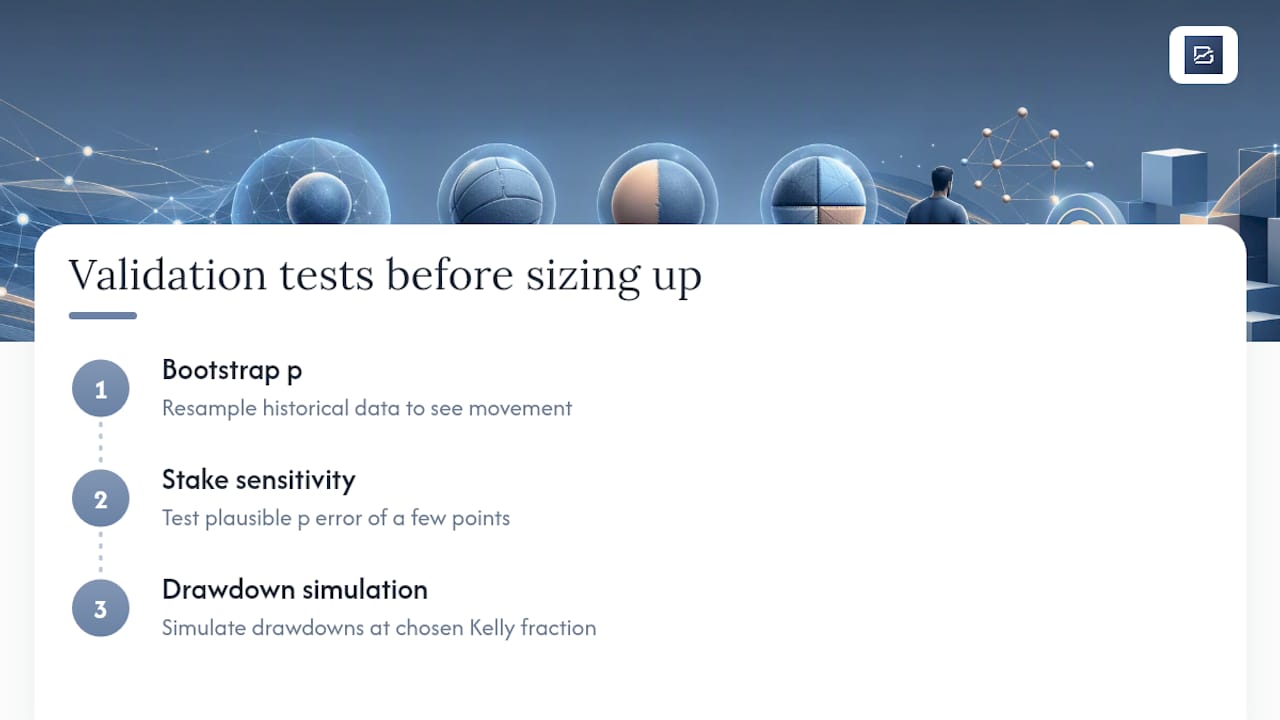
Three tests worth running before sizing up: bootstrap your p estimate across resampled historical data to see how much it moves, check how sensitive your recommended stake is to a plausible p error of a few percentage points, and simulate drawdown runs at your chosen fraction before you experience one for real.
When I’d Use Kelly Versus Flat Staking
Kelly earns its place once you’ve got a validated model and CLV evidence showing your numbers beat the closing line consistently, not just a hunch that feels sharp this week.
Without that validation, flat or percentage staking is the more honest choice. It’s not exciting, but it doesn’t ask a shaky probability estimate to do more work than it can handle.
For most readers who do have real edge, fractional Kelly, half or quarter, is the sensible default. Watch your CLV, pause the strategy when it drifts negative, and backtest before you ever size up toward full Kelly.
Backtest Your Kelly Strategy Before You Bet It Live
A backtesting platform is the alternative to guessing at your p and hoping the arithmetic holds up. Instead of building a Kelly staking rule on instinct and finding out months later whether the probability estimate behind it was any good, you build the rule once, no code, no spreadsheet, and run it against historical matches to see how it would have actually performed.
Stability analysis shows how sensitive your recommended stake is to errors in your win probability, which is exactly the input that breaks most Kelly-based strategies in practice. Automated tracking then carries that same validation into live bets, logging closing line value and outcomes so you know whether your edge is holding up or quietly decaying. If you’re ready to see how your staking rule would have performed before risking a real bankroll on it, start backtesting your strategy for free.
Sources
This article is general information, not a substitute for advice from a qualified financial advisor. Consult a qualified financial professional about your own circumstances before acting on anything here.
FAQ
Does the Kelly Criterion actually work?
It works as designed, maximizing long-term growth, but only when the probability estimate you feed it is accurate; a wrong p produces a wrong, sometimes damaging, stake regardless of how correct the formula’s math is.
How do you calculate Kelly Criterion for sports betting?
Convert your odds to decimal form, subtract 1 to get b, estimate your true win probability as p, set q = 1 − p, then compute f* = (b·p − q) / b to get the fraction of your bankroll to stake.
Does Warren Buffett use the Kelly Criterion?
There’s no confirmed evidence Buffett applies Kelly the way bettors do for wager sizing; Kelly-style thinking shows up informally in some investment approaches to position sizing, but the connection to Buffett specifically is not established.
What are the biggest risks of using the Kelly Criterion?
The main risks are estimation error in your win probability, which can eliminate expected growth entirely if overstated, plus large drawdowns even with a real edge and bookmaker limits that cap how much you can actually stake.
Should I use full Kelly or fractional Kelly?
Most sports bettors should use half or quarter Kelly, since these preserve much of full Kelly’s growth rate while cutting volatility and drawdown severity substantially.