Over/Under Playbook for Sports Bettors: Five Season Soccer Backtests
Over/Under Playbook for Sports Bettors: Five Season Soccer Backtests
The most reliable over/under betting strategy is a data-first workflow: model a fair total, shop the line, time your bet, and size stakes with discipline. This article breaks down sport-specific triggers for the NFL, NBA, MLB, NHL, and soccer, then shows published five-season backtest results for real totals systems. Jump to “Practical strategies and timing” for the tactical checklist if you already know the basics.
TL;DR:
- Building a reliable totals betting system requires modeling a fair line, using disciplined staking, and shopping between sportsbooks to find value.
- Total line movements often indicate sharp money or market sentiment, especially when moving against public betting trends or across multiple books.
- Sport-specific signals, such as wind in the NFL or pitcher quality in MLB, are crucial for timing bets and assessing potential value.
- Testing and backtesting your model on multiple seasons and sports is essential before risking real money, with tools like Backstedge simplifying this process.
- A fractional Kelly stake and avoiding correlation stacking or chasing losses help protect your bankroll from common betting mistakes.
Table of Contents
- What Is an Over/Under Betting Strategy and How Do Totals Lines Work?
- Types of Totals Markets and Where the Edges Hide
- Which Sport-Specific Signals Actually Move a Total?
- What’s the Best Way to Time and Size an Over/Under Bet?
- How Much Should You Stake on Totals, and What Mistakes Cost the Most?
- What the Data Says: Over/Under 2.5 Backtested Over 5 Seasons
- How Do You Build and Backtest Your Own Totals System?
- Test Your Own Totals Rules Before You Stake a Dollar on Them
- Sources
- FAQ
What Is an Over/Under Betting Strategy and How Do Totals Lines Work?
A totals bet asks one question: will the combined score of both teams land over or under a number the sportsbook sets? That number is the “total” or “line,” and it usually carries a half-point (like 47.5) to prevent a tie, called a push, where your stake is simply returned. Whole-number totals (47, not 47.5) can push, which changes how you should size a bet near a key number.
Sportsbooks build totals from pace and efficiency models, then adjust for injuries, weather, and market action. The Krok Odds totals guide explains that oddsmakers price totals from possession counts and scoring efficiency before layering in situational factors. The odds attached to the number, often shown as -110 or -115, represent the vig, the sportsbook’s built-in cut, meaning you need to win more than half your bets just to break even.
Line movement tells its own story:
- A total moving despite even public betting usually signals sharp money.
- A total drifting toward the public’s favorite side often reflects recreational volume, not new information.
- Steam moves across multiple books at once usually mean a syndicate has moved first.
Types of Totals Markets and Where the Edges Hide
Full-game totals get the most action and the tightest pricing, which makes them the hardest market to beat consistently. Derivative markets, first-half totals, first-quarter totals, team totals, and alternative totals, carry wider vig and thinner liquidity, but that same thinness is where sharper, narrower models can find value.
A few patterns worth tracking:
- Team totals isolate one side’s scoring, which is cleaner when your edge is about one team’s pace or injury news rather than the whole game.
- First-half totals reduce garbage-time noise in blowouts, useful in the NBA and NFL when a team totals model says a game will be lopsided.
- Alternative totals (buying or selling points) shift both the number and the price, and the vig on these moves fast if you’re not shopping multiple books.
Monitor team totals and first-half markets first if you’re building a new model. They react to a narrower set of inputs, which makes it easier to isolate whether your edge is real or noise.
Which Sport-Specific Signals Actually Move a Total?
Every sport prices totals off different inputs, and the signals worth checking take about two minutes once you know where to look.
- NFL: Wind above 15 to 20 mph reliably suppresses passing efficiency and total scoring. Watch totals sitting within a point of a key number (37, 41, 44), and note that divisional rematches tend to trend under the market’s number as coaches game-plan more conservatively.
- NBA: Track possessions per game, not just points, since pace swings faster than efficiency does. Back-to-back games, especially the second night, tend to suppress scoring, and a star’s late scratch can move a total by two to four points within minutes. Overtime adds a shortened extra period that skews modeling if you don’t adjust for it.
- MLB: Starting pitcher quality (strikeout rate, recent form) matters more than any other single input. Ballpark factors and wind direction at hitter-friendly parks like Coors Field can swing a total by a full run, and temperature above 85°F tends to favor scoring.
- NHL: Check the confirmed goalie matchup before anything else, since backup goalies routinely push totals up half a goal or more. Most totals sit at 5.5 or 6, so a single goal swings the result.
- Soccer: Expected goals (xG) trends and both-teams-to-score rates flag attacking matchups. The 2.5 line dominates the market, and team totals help when one side’s attack is live but the other is defensively sound.
The StatsBench NBA guide breaks down possessions-based modeling in more depth if basketball is your primary sport.
What’s the Best Way to Time and Size an Over/Under Bet?
Build a rough fair-value number before you look at the market line, otherwise you’ll unconsciously anchor to whatever the book posted. A workable mini-model combines five inputs: pace (possessions or plays per game), offensive and defensive efficiency, confirmed lineup or starter news, venue factors, and weather. Weight pace and efficiency heaviest, since they’re the most stable across a season, and treat weather and late news as adjustments, not the foundation.
Line shopping across multiple sportsbooks is not optional if you’re serious about this. A half-point or one to three points of difference on a total changes your win rate meaningfully over hundreds of bets, even though it feels trivial on any single wager.
Timing splits into two distinct edges:
- Opening-line edge: betting within the first hour a total is posted, before the market has absorbed sharp action, works best when your model disagrees sharply with a book’s early number.
- Information edge: waiting for confirmed lineups, weather reports, or late scratches gives you certainty the opening line didn’t have, at the cost of a worse number since the market has already adjusted some.
Live totals move fastest when weather shifts mid-game (rain starting in a low-scoring soccer match) or when foul trouble and pace changes emerge in the NBA. The XCLSV totals guide notes that public bettors lean toward overs by default, which creates recurring value on unders when your model and the crowd disagree.
Pro Tip: Keep a running note of your model’s total versus the closing line on every bet, win or lose. If your numbers consistently beat the close (positive closing line value), you have a real edge even during a losing stretch.
How Much Should You Stake on Totals, and What Mistakes Cost the Most?
A fractional Kelly approach, betting 0.25 to 0.5 of what full Kelly criterion suggests, protects you from the model errors that inevitably creep into any totals system over a long season.
The mistakes that quietly drain a bankroll:
- Correlation stacking: betting the same game’s total, a team total, and a related prop is really one bet three times over, not diversification.
- Parlay compounding: stacking multiple totals into a parlay multiplies the vig against you on every leg.
- Chasing losses: increasing stake size after a loss to “get even” is the fastest way to turn a small edge into a big drawdown.
- Small-sample overfitting: a system that looks great over 40 bets often falls apart over 400.
- Ignoring closing line value: if you’re not beating the close over time, you’re likely not beating the market either.
What the Data Says: Over/Under 2.5 Backtested Over 5 Seasons
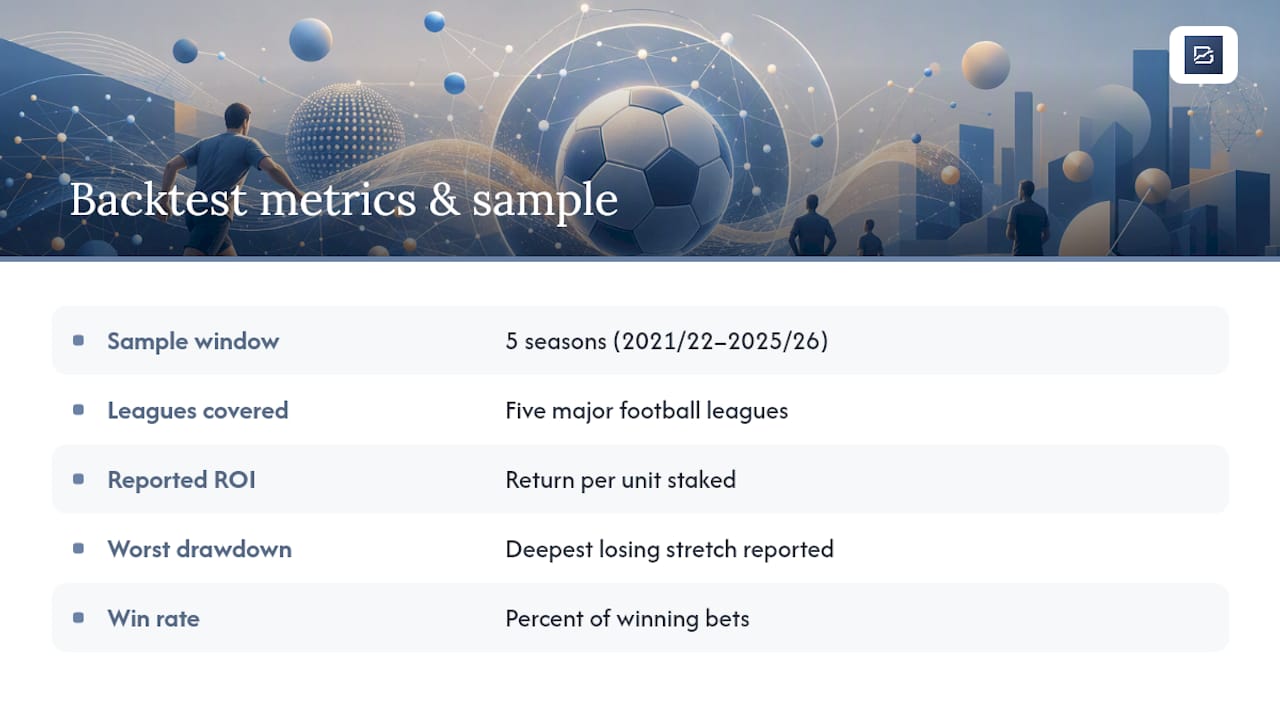
Published backtests remove the guesswork from soccer totals betting. Backstedge ran three over/under 2.5 goals variants across five major football leagues, five seasons from 2021/22 through 2025/26, using real closing odds and flat one-unit stakes.
Each strategy page carries its own exact ROI, win rate, worst drawdown, and total bet count for the five-season window. ROI tells you the return per unit staked over the full sample, while worst drawdown shows the deepest losing stretch you’d have needed to survive to see that return. A strategy with a strong overall ROI but a brutal drawdown demands more bankroll cushion than the headline number suggests, and a sample of a few hundred bets carries more confidence than one of a few dozen.
These three backtests cover football (soccer) only. Applying a soccer-derived over/under system to the NFL, NBA, MLB, or NHL without independently building and testing it there first is a mistake. Scoring distributions, schedule density, and market efficiency differ too much between sports for one system to transfer cleanly.
How Do You Build and Backtest Your Own Totals System?
- Define your rule set first: the sport, the specific filter (team pace above a threshold, a weather condition, a goalie tier), and the exact totals line you’re targeting.
- Source historical data covering several full seasons, not just a recent hot stretch.
- Split your sample into in-sample testing (to build the rule) and out-of-sample validation (to confirm it isn’t a fluke).
- Paper test the rule against live lines for a stretch before staking real money, and track closing line value the entire time.
Don’t go live until you’ve cleared a meaningful sample size and set a hard bankroll limit for the strategy’s early run. A rule that only “works” over 25 bets hasn’t proven anything yet.
Pro Tip: Weather feeds, automated line trackers, and no-code backtesting platforms like Backstedge save the hours of spreadsheet work that usually make bettors quit testing before they get a real answer.
Test Your Own Totals Rules Before You Stake a Dollar on Them
Backstedge is built for exactly the workflow this article just walked through. Instead of guessing whether your “wind above 15 mph plus a low-total defense” rule actually wins, you build it visually, no spreadsheets, no code, and run it against seasons of real historical odds to see the ROI, win rate, and worst drawdown before you ever place a live bet.
The platform’s published backtests for over 2.5, over 2.5 in high-scoring matchups, and under 2.5 in low-scoring matchups show exactly this process in action, five seasons of real closing odds, flat stakes, no cherry-picked windows. You can build a soccer totals rule from scratch, validate it against 2021/22 through 2025/26 data, and see its stability before risking a cent. Backstedge offers a Free plan to start, with paid plans unlocking expanded features and higher quotas. For current prices, see the pricing page on Backstedge’s website. Start building your own totals strategy and see what your rule would have actually returned.
Sources
FAQ
Does Overtime Count Toward NBA or NFL Totals?
Yes, overtime scoring counts toward the final total in both the NBA and NFL. This matters for modeling because overtime periods run shorter than regulation, so their scoring pace differs from the rest of the game.
How Many Bets Do I Need Before Trusting a Totals System?
There’s no fixed magic number, but a system tested over a few dozen bets is far more likely to be noise than a real edge. Split your data into a building sample and a separate out-of-sample validation window, and treat any system that hasn’t cleared both stages as unproven.
What Percentage of My Bankroll Should I Risk on a Totals Bet?
A fractional Kelly approach, betting a quarter to half of what full Kelly criterion suggests, offers a practical cushion against model error.
Can I Use Backstedge to Test NBA or NFL Totals Systems?
Backstedge’s published backtests currently cover football (soccer) strategies only, including three over/under 2.5 variants tested across five seasons. Its no-code building tools work for constructing rule-based strategies, but the published five-season results are soccer-specific and shouldn’t be assumed to transfer to other sports.
When Is the Best Time to Bet a Total, Early or Late?
Betting early captures value before the market has absorbed sharp action, which works best when your model disagrees strongly with an opening number. Betting late lets you incorporate confirmed lineups and weather, at the cost of a line that’s already adjusted to reflect that same news.