Most Classic Soccer Betting Systems Lose in Five Seasons of Backtests

Most Classic Soccer Betting Systems Lose in Five Seasons of Backtests
A soccer betting system is a repeatable, testable rule set for deciding what to bet, when, and how much. The most reliable approach is not a clever staking pattern. It combines value selection, disciplined bankroll management, and rigorous backtesting against real closing odds. Most classic systems, when backtested honestly, lose money over five seasons. Backstedge is built to show you exactly which ones do, and to help you validate whether your own idea is any different.
TL;DR:
- Most classic soccer betting systems tend to lose money over five seasons when tested against real market odds, especially those based on broad, unfiltered rules.
- Building a sustainable system requires focusing on a narrow league, market, and specific edge, with entry conditions based on data-driven filters like expected goals, recent form, and injuries.
- Proper bankroll management involves flat, 1-2% stakes and thorough backtesting on historical odds before transitioning to live betting to avoid chasing losses with progressive systems like Martingale.
- Using real closing odds for backtesting and gradual stake scaling, along with strict record-keeping, helps distinguish genuine edge from luck while monitoring market responses.
- Most profitable long-term betting relies on focusing on markets like Asian handicap and totals, where tighter margins provide a better opportunity for models with a true advantage.
Table of Contents
- What Are the Core Components of a Soccer Betting System?
- Do Progressive Staking Systems Like Martingale Actually Work?
- How Do You Build a Repeatable Soccer Betting System?
- What the Data Says: Backstedge Backtests of Classic Soccer Betting Systems
- How Do You Move From Backtest to Live Betting Safely?
- Is Soccer Betting Legal, and What Are the Ethical Considerations?
- Build and Backtest Your Own System in Backstedge
- Primary Sources and Further Reading
- Sources
- FAQ
What Are the Core Components of a Soccer Betting System?
Every system that survives contact with real markets shares the same skeleton, regardless of which league or market it targets.
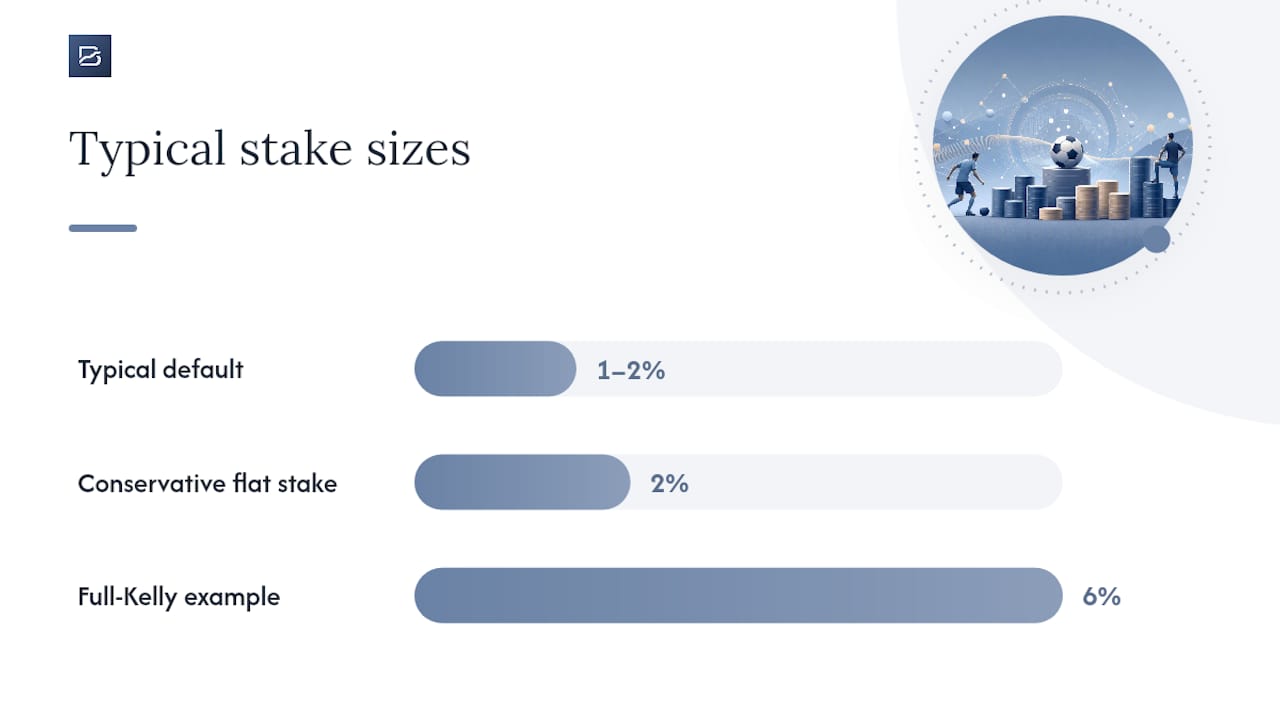
Bankroll management comes first, not last. Most disciplined bettors size stakes at 1% to 2% of total bankroll per bet as a default, a figure that shows up consistently in industry guidance on soccer betting strategy. Some experienced modelers use fractional Kelly, betting a quarter or half of what the full Kelly formula suggests, because full Kelly sizing assumes your edge estimate is exact. It almost never is. A 2% flat stake on a mediocre edge does less damage than a 6% Kelly stake on an edge that turns out to be an illusion.
Closing line value (CLV) is the single best predictor of long-run profitability. If you consistently bet at odds better than the closing line, you are systematically finding value before the market corrects. The SoccerNews guide to soccer betting strategy treats CLV tracking, line shopping, and bankroll discipline as the core habits separating sustainable bettors from people who happen to win for a few weeks. Win rate over a small sample tells you almost nothing. CLV over hundreds of bets tells you whether you actually have an edge.
Statistic callout: Bookmakers correctly predict Major League Soccer results only about 47% of the time, a lower accuracy rate than in more efficient European leagues, according to analysis of MLS market pricing. That gap is exactly where specialization in a narrower, less-scrutinized league can create room for an informed edge.
Market selection matters as much as the model behind it:
- 1X2 (match result): simplest market, but highest bookmaker margin relative to the information it prices; best for straightforward win/draw/loss edges backed by a clear model.
- Asian handicap: removes the draw, tightens margins, and rewards precise strength-differential models.
- Totals (over/under goals): works well when your model has a real edge on expected goal counts, particularly in low-scoring or high-tempo leagues.
- Both teams to score (BTTS): a narrower bet that rewards teams’ attacking and defensive tendencies more than overall strength.
- Props and accumulators: higher variance, higher combined margin. Compounding multiple legs compounds the bookmaker’s edge too, which is why tools like ParlayGeeks exist mainly to help bettors see the true combined odds before committing.
Keep a record for every single bet: date, league, match, market, stake, odds taken, closing odds, the reason for the bet, and the result. Without that log, you cannot calculate CLV, cannot spot which market or league is actually profitable, and cannot separate luck from edge.
In-play betting deserves a short, strict rule set of its own. React only to triggers you defined before kickoff, such as a specific team going down a goal while dominating expected goals, not to gut feeling in the 70th minute.
Do Progressive Staking Systems Like Martingale Actually Work?
No. Staking patterns change the shape of your variance, not the size of your edge. That distinction gets lost constantly in betting forums, and it is worth spelling out plainly.
Flat staking means betting the same unit size on every wager regardless of confidence or recent results. It is the cleanest baseline for evaluating a system because it isolates the quality of your selections from the noise of variable bet sizing. Every strategy page on Backstedge’s backtest library uses flat one-unit stakes for exactly this reason. If a system can’t turn a profit at flat stakes, no staking pattern layered on top will fix it.
Fractional Kelly sizes each bet according to your estimated edge and the odds offered. The full formula is edge divided by odds minus one, but using a fraction of that (a quarter or half) protects you from the ruinous swings that come from betting your true theoretical Kelly stake on an edge you only estimated. This works, but only when your probability estimates are genuinely calibrated.
Progressive systems fail for a different reason entirely. Martingale doubles your stake after every loss so one win recovers all prior losses. The 1-3-2-6 system scales stakes across a sequence of results. Neither changes the underlying probability of any bet winning. Both increase the size of the loss you’re risking exactly when a losing streak is already hurting you, and both run into bookmaker maximum-stake limits before they can “recover” a long losing run. A broad review of soccer betting systems makes the same point: no staking pattern creates positive expected value where none existed before.
Practical guidance, in order of priority:
- Establish your edge with a backtest before you touch stake sizing at all.
- Default to flat stakes at 1% to 2% of bankroll while you’re validating a new idea.
- Move to fractional Kelly only once you have a large enough sample to trust your probability estimates.
- Set a stop-loss at the segment level (by league, market, or month) so one bad stretch doesn’t bleed into your whole bankroll.
- Never use a progressive system to “chase” a losing streak back to even.
Pro Tip: Run the same set of bets through flat staking and through a Martingale sequence in a spreadsheet before you ever risk real money on the progressive version. Watching the Martingale bankroll curve hit a bookmaker’s max-stake ceiling after four or five straight losses is more convincing than any explanation.
How Do You Build a Repeatable Soccer Betting System?
Narrow the scope before you do anything else. A system trying to price every match in every top league is fighting the most efficient, most heavily modeled markets in the sport. A system focused on one league, one market, and one type of situational edge has a much better shot at finding a real gap, which is part of why smaller or less efficient leagues attract disciplined specialists in the first place.
Design your entry rules as binary filters, not vague intuition. A workable rule structure looks like this: bet the home team when the bookmaker’s implied probability is below your model’s probability by at least 5 percentage points, the expected goals differential over the last six matches favors the home side by 0.4 or more, and no more than one first-choice attacking player is missing from the lineup. Every condition is checkable against data. Nothing depends on how the game “feels.”
The data inputs that matter most:
- Expected goals (xG): the standard measure of chance quality per shot, and the foundation of most credible predictive models today, as StatsBomb’s explainer on expected goals lays out in detail.
- Shots and shot quality trends over a rolling window, not just season totals.
- Rest days and fixture congestion, which shift performance more than most bettors assume.
- Head-to-head history, weighted lightly since it’s a small sample and easily overstated.
- Injuries and suspensions, particularly among players who drive a disproportionate share of a team’s xG.
- Referee tendencies, relevant mainly for cards and penalty-related props.
Statistical modelers commonly build on Poisson or Dixon-Coles distributions to translate expected goals into match-outcome probabilities, an approach detailed in guides to finding real betting edges that also stress removing the bookmaker’s margin before comparing your model’s numbers to the market’s.
Backtesting protocol matters as much as the rule itself. Test against real historical closing odds, not opening lines, since closing odds reflect the sharpest available pricing. Split your data into an in-sample period for building the rule and an out-of-sample period for testing it, and if possible run a walk-forward test that rolls the training window forward through time. You need a large enough bet count for the result to mean anything: a system that goes 12 and 3 across fifteen bets tells you nothing reliable, no matter how good the win rate looks. A step-by-step framework for building soccer betting systems recommends treating anything under a few hundred bets as directional at best.
| Stage | What you do | What you’re checking |
|---|---|---|
| Paper test | Apply rules to historical data without staking real money | Does the rule set produce a plausible edge across seasons? |
| Small-scale live test | Bet real money at a fraction of target stake | Does live performance track the backtest, including CLV? |
| Scale-up | Increase stake toward target size gradually | Do results hold as stake size and bet frequency grow? |
| Ongoing monitoring | Log every bet and review monthly | Is the system drifting, or are markets adapting to it? |
Once your rules are testable, log every bet with the same fields you’d use for a discretionary system. Watch how bookmakers respond, too. Sustained profitable betting on soft markets often triggers stake limits, and slippage between the odds your model wants and the odds you can actually get is a real cost that backtests on paper sometimes underweight.
What the Data Says: Backstedge Backtests of Classic Soccer Betting Systems
Backstedge publishes real backtests of eleven classic football betting systems, each run across five seasons (2021/22 through 2025/26) in five major leagues, using real closing odds and flat one-unit stakes. No opening lines, no theoretical pricing, no cherry-picked windows. That’s the same methodology described above applied at scale, and it’s worth looking at what it actually shows before you build anything yourself.
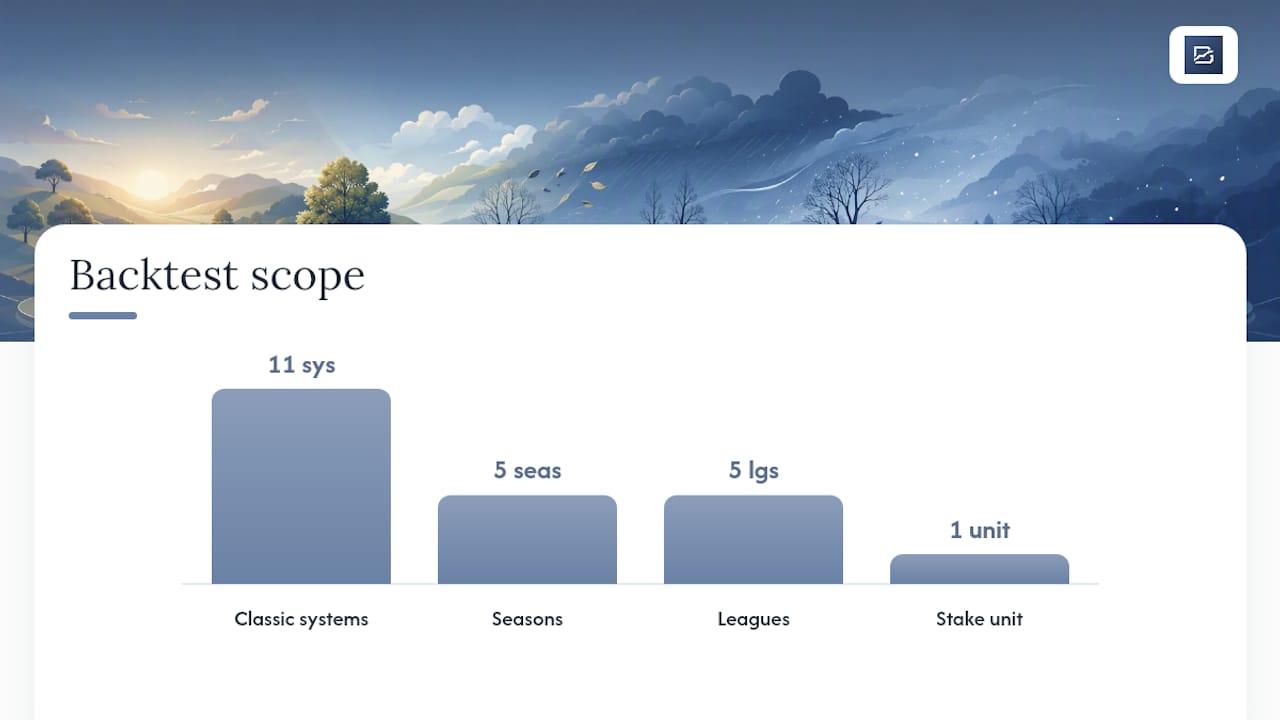
The headline finding is uncomfortable if you came looking for a shortcut: most of these classic systems lose money over five full seasons. That’s not a flaw in the testing. It’s the entire point of testing in the first place.
Strategies covered on the Backstedge betting strategies library include:
- Home favorites — backing the home team whenever they’re priced as favorites, regardless of margin.
- Home underdogs — backing home teams priced as underdogs, a classic “value in disrespect” theory.
- Away favorites — backing road teams priced as favorites.
- Draws between close rivals — betting the draw when two teams are closely matched on form or standing.
- Over 2.5 goals — a blanket totals bet with no team-specific filter.
- Both teams to score (BTTS) — backing BTTS across all qualifying matches.
- Under 2.5 between low-scoring teams — a totals bet filtered by recent scoring history.
- Home side in form — backing home teams on a defined recent-form streak.
- Top-six home team — backing home teams inside their league’s current top six.
- Rested home team — backing home teams with a rest-day advantage over their opponent.
Each strategy page reports return on investment, worst drawdown, total number of bets, and win rate, broken down season by season across the full five-year window. That’s the level of detail you need to judge whether a pattern is real or just five seasons of noise that happened to land on the right side.
The pattern across the library is consistent with what the staking-systems discussion above predicts: broad, unfiltered rules built on a single obvious signal (home favorite, over 2.5 goals) tend to bleed money once the bookmaker’s margin is applied at real closing prices, because the market has already priced in the obvious part of the edge. The systems that show more stability tend to be the ones with a tighter filter layered on top of the base rule, such as combining home advantage with a specific form or rest-day condition rather than betting the raw category alone. Sample size matters too: a strategy tested across five seasons and five leagues has enough bet volume to trust the ROI figure in a way that a fifteen-bet hot streak never earns.
The takeaway isn’t that soccer betting is unbeatable. It’s that the vast majority of “systems” repeated across forums and tipster sites have already been arbitraged by the market long before you found them, and the only way to know if yours is different is to run the actual numbers.
How Do You Move From Backtest to Live Betting Safely?
Moving a validated idea into real money follows a specific sequence, and skipping steps is the most common way bettors turn a good backtest into a bad live result.
- Paper-test the rule set for a defined period or a minimum bet count (aim for at least 100 to 200 qualifying bets) before risking any capital.
- Start live betting at a fraction of your intended unit size, such as a quarter of target stake, and confirm that your live closing line value matches what the backtest predicted.
- Scale up gradually only after live results and CLV stay consistent with the backtest over a meaningful stretch.
- Set a hard stop-loss rule in advance, such as pausing the system if drawdown exceeds a defined percentage of allocated bankroll, and treat that trigger as non-negotiable.
- Spread activity across more than one bookmaker or market segment where practical, since profitable systems tend to attract stake limits, and relying on a single operator leaves you exposed if that account gets restricted.
Is Soccer Betting Legal, and What Are the Ethical Considerations?
Legal status for sports betting varies by jurisdiction and changes over time, so check your local and state or national regulations before placing any bet, and only use licensed, regulated operators where betting is permitted. This article covers system design and testing methodology. It is not a legal opinion on where or whether you’re permitted to bet.
Ethically, the line between a disciplined system and a problem starts with how you respond to losses. A real system has predefined rules, predefined stakes, and a predefined stop-loss. If you find yourself increasing stakes to chase a losing run, abandoning your rules mid-sequence because “this one feels different,” or betting money earmarked for something else, those are warning signs regardless of how sound your original model was.
Backtesting itself carries an ethical dimension too: publishing or trusting a system’s results requires honesty about sample size and about strategies that were tried and discarded before landing on the one you’re showcasing. A system that “works” only because nine other versions were tested and quietly dropped isn’t validated, it’s curve-fit. Resources like BeGambleAware offer guidance on staying within safe limits and on recognizing when betting has stopped being a disciplined activity and started being a compulsion. If any part of your betting behavior resembles the second description, that matters more than any ROI figure.
Build and Backtest Your Own System in Backstedge
Every idea in this article, from bankroll rules to xG filters to closing-line tracking, is only useful once you can prove it holds up against real history. That’s the gap Backstedge fills. Instead of building spreadsheets or hand-tracking hundreds of bets, you set your rules visually, no code required, and Backstedge runs them against historical matches with real bookmaker odds.
The platform mirrors the exact workflow this article walks through: build your rule set, validate it against five seasons of historical data with real closing odds, and then track it automatically as new qualifying matches appear. The published strategy library already shows you what happens when eleven classic systems get tested this way, including the ROI, worst drawdown, and win rate for each one, so you can see exactly what a rigorous backtest looks like before you build your own. Stability analysis flags whether a strategy’s results are consistent across seasons or dependent on one lucky stretch, which is the exact question a raw win rate can’t answer.
Backstedge offers a Free plan to get started, along with Pro and Advanced paid plans for expanded rule complexity and higher tracking quotas, all available at Backstedge. If you’ve got a rule in mind, whether it’s a refined version of “home side in form” or something built entirely from your own xG filters, the next step is putting it through a real five-season backtest rather than trusting your gut on it.
Primary Sources and Further Reading
- Backstedge’s strategy backtest library, covering eleven classic systems with ROI, drawdown, and season-by-season figures
- StatsBomb’s explanation of expected goals (xG), the standard reference for chance-quality modeling
- BeGambleAware, for responsible gambling guidance and support
- BetMzansi’s bankroll management guide, for beginner-level staking principles
FAQ
What Is the Best Soccer Betting Strategy?
There’s no single best strategy, but the approach with the strongest track record combines value selection, disciplined unit sizing (typically 1% to 2% of bankroll), and tracking closing line value over a large sample, as outlined in SoccerNews’s strategy guide. Backtesting any specific rule against real closing odds, the way Backstedge’s strategy pages do, is the only way to know whether a strategy idea actually holds up.
Which Platform Is Best for Backtesting Soccer Betting Systems?
Backstedge is built specifically for this, letting bettors create custom rules without code and test them against historical matches with real closing odds. Its published backtests of eleven classic systems give a transparent benchmark for ROI, drawdown, and win rate that most tipster sites never show.
What Are the Most Effective Betting Systems?
Most classic, unfiltered systems, like blanket over 2.5 goals or backing every home favorite, tend to lose money once tested against five seasons of real closing odds, based on Backstedge’s published backtests. Systems that layer a specific, data-backed filter on top of a base rule, such as combining home advantage with rest days or recent form, tend to show more stability, though results still vary by league and sample size.
What Are the Best Markets to Bet on in Soccer?
Asian handicap and totals markets often carry tighter bookmaker margins than straight 1X2 bets, making them attractive when your model has a genuine edge on strength differentials or expected goal counts. Both teams to score and props can work for narrower, well-defined edges, but accumulators compound the bookmaker’s margin across every leg, which is why tools like ParlayGeeks exist to show bettors the true combined price before committing.